This site mainly deals with various use cases demonstrated using Python, Data Science, Cloud basics, SQL Server, Oracle, Teradata along with SQL & their implementation. Expecting yours active participation & time. This blog can be access from your TP, Tablet & mobile also. Please provide your feedback.
A common misunderstanding is that smaller software must be less capable. The source materials present the opposite argument. NullClaw is described as small not because it removes architectural discipline, but because it reduces avoidable overhead.
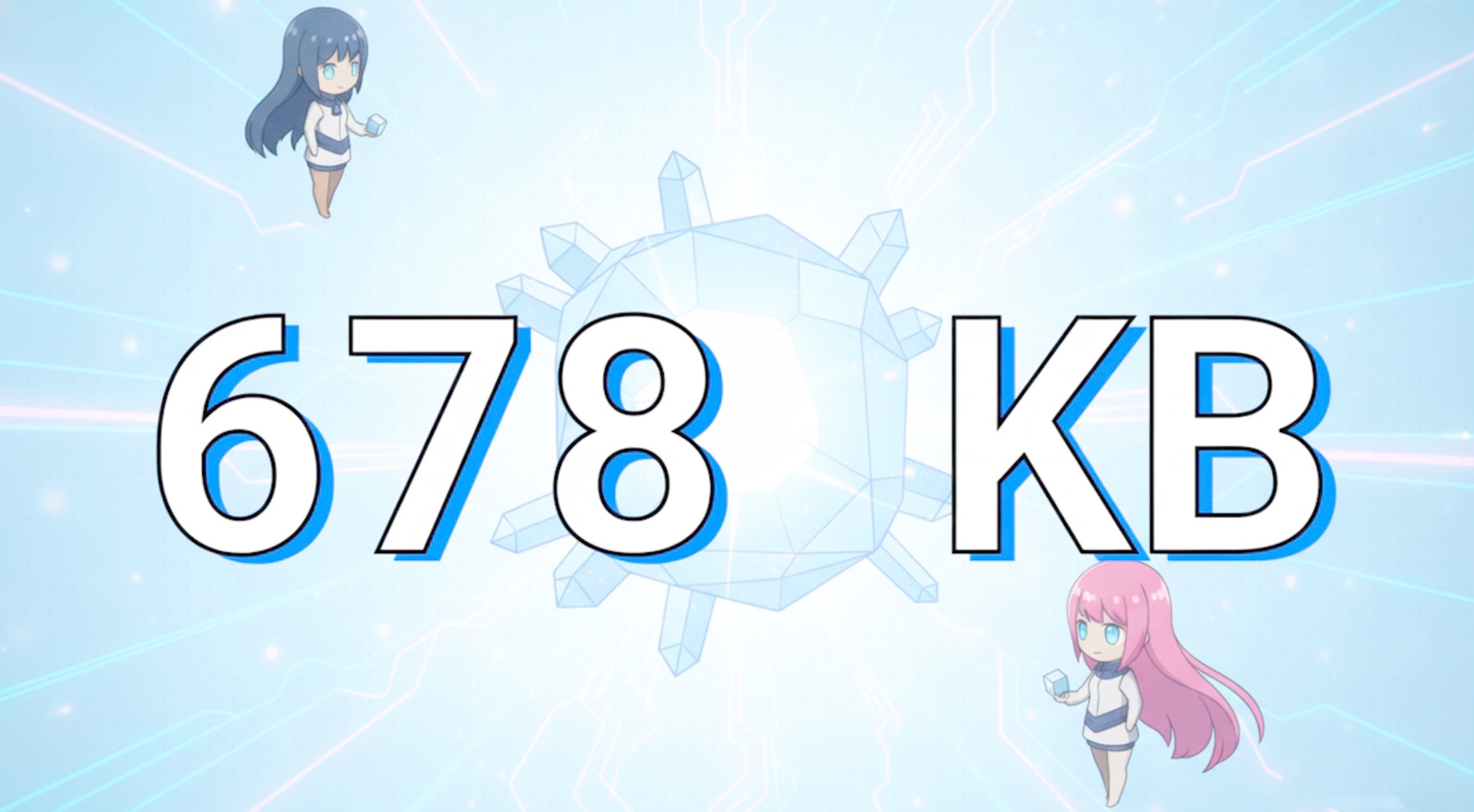
The framework is presented as a 678 KB binary with approximately 1 MB peak memory, yet it still supports modular providers, communication channels, memory backends, tunnels, observability, and direct hardware peripherals. The key architectural idea is not minimalism as limitation. It is minimalism as control.
Security Through Minimalism
The main reasons the Claw-family ecosystem dependency-heavy model is described as having a large attack surface, including more than 500,000 lines of code and a plugin marketplace associated with the source, with a 10.8% malware rate. The document also references CVE-2026-25253, described as a dynamic token leak that exposed more than 40,000 active instances.
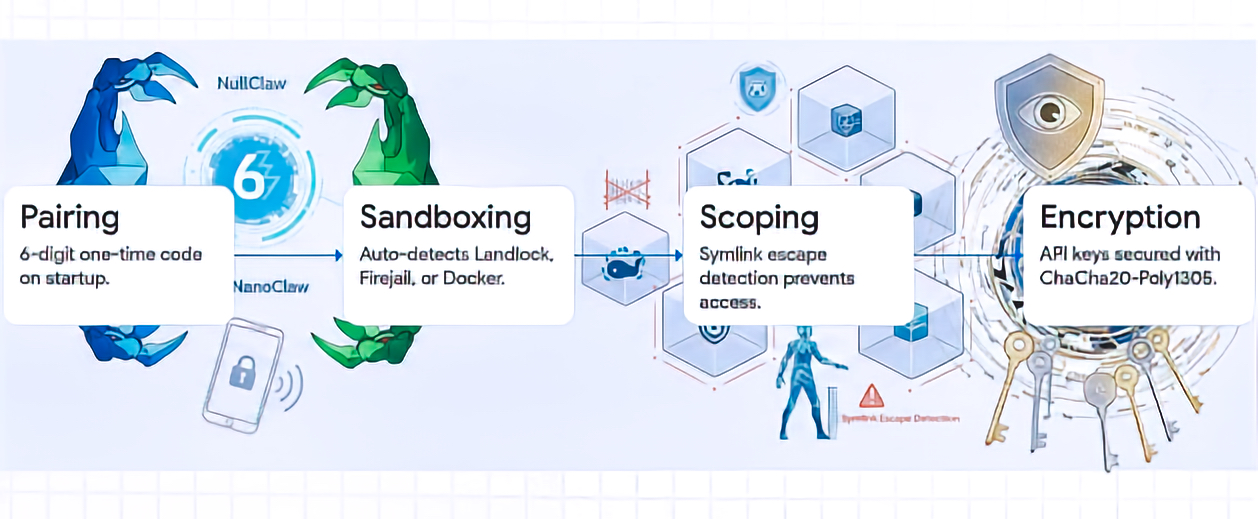
NullClaw’s security model is framed as layered and local-first:
PIN-pairing authentication for initial bearer token exchange:
NullClaw uses a 6-digit one-time pairing code, exchanged through POST /pair, to obtain a bearer token. The docs call it a “pairing code,” not necessarily a persistent PIN. Pairing codes are single-use and expire after a configurable period; bearer tokens persist until revoked.
ChaCha20-Poly1305 encryption for API keys and sensitive credentials:
NullClaw documents API-key encryption at rest using ChaCha20-Poly1305 AEAD, with encrypted fields using an enc2:prefix. It also notes that decrypted values are used at runtime and are not written back in plaintext.
Memory zeroing for specific private-key material:
This is documented specifically for Nostr private keys: they are encrypted at rest, decrypted only while the channel runs, and zeroed on channel stop. I would avoid implying that every secret or every private key in every subsystem is zeroed unless you verify that in code or docs.
Kernel-level sandboxing through Landlock, Firejail, Bubblewrap, or Docker:
NullClaw supports Landlock, Firejail, Bubblewrap, and Docker. However, only Landlock is specifically kernel-level LSM. Firejail uses seccomp and namespaces, Bubblewrap uses user namespaces, and Docker uses container isolation. Better wording: “OS-level or container-based sandboxing through Landlock, Firejail, Bubblewrap, or Docker.”
Filesystem scoping through workspace_only and path-resolution checks:
The docs state that file operations are restricted to ~/.nullclaw/workspace/ by default with workspace_only = true, and path validation includes null-byte blocking, absolute path resolution, workspace-boundary checks, additional allowed paths, and symlink escape detection through realpath resolution.
Marketplace-free deployment to reduce centralized plugin supply-chain exposure:
This is a reasonable architectural interpretation, but I would not present it as an officially documented NullClaw security control. The docs support adjacent ideas—static binary, no runtime/framework overhead, pluggable systems, no lock-in, and configurable providers/tools—but I did not find official wording that frames “marketplace-free deployment” as a security layer or supply-chain mitigation.
The principle is straightforward: fewer moving parts can mean fewer places for vulnerabilities to hide. For technical readers, the security value comes from auditability, scoped execution, deterministic behavior, local secret protection, and a reduced dependency chain.
Swappable Everything Without Recompiling
The NullClaw’s vtable interface architecture is a way to preserve modularity without returning to heavy runtime dependencies. In practice, this means subsystems can be swapped through configuration rather than by changing the core code.
This means an organization can change the “brain,” messaging channel, memory layer, or deployment route without rebuilding the whole system.
The design reflects interface-based modularity: concrete implementations depend inward on stable boundaries. The source emphasizes that this keeps the agent provider-agnostic and reduces vendor lock-in. It also notes an important constraint: strict manual memory management creates risk when ownership rules are violated.
RAG Without a Heavy External Database
Retrieval-Augmented Generation, or RAG, is often associated with external vector databases and heavier cloud infrastructure; however, RAG does not require that architecture. NullClaw uses a SQLite-backed local memory layer that combines semantic and lexical retrieval, allowing the agent to retrieve information by both meaning and exact wording.
NullClaw’s hybrid memory strategy uses two retrieval signals:
Vector subsystem: Stores embeddings as BLOBs in SQLite and uses cosine similarity to capture semantic intent.
Keyword subsystem: Uses SQLite FTS5 virtual tables with BM25 scoring to preserve exact identifiers, names, IDs, commands, and domain-specific terminology.
Conceptually, the default weighted merge can be expressed as:
This should be understood as a weighted blend of normalized retrieval scores, because vector similarity and BM25 scores are not naturally on the same scale. In particular, SQLite FTS5’s BM25 ranking gives better matches numerically lower scores, so keyword scores need to be transformed or normalized before being combined with cosine similarity.
The value of this hybrid approach is that the agent can retrieve both the meaning and the exact wording of prior information. For example, it can understand the intent of a question while still recognizing a specific product name, ticket number, file path, command, or technical identifier.
When NullClaw uses its default SQLite memory backend, the memory engine can run locally with the agent. This reduces dependency on a separate vector database service and can lower network overhead and infrastructure complexity, especially in local-first or edge-oriented deployments.
From Chatbots to Robotic Companions
The Claw-family evolution can be framed as a movement from screen-based chatbot interaction toward agents that operate closer to the “point of action.” ROSClaw extends this direction by integrating the OpenClaw agent runtime with ROS 2, enabling foundation models to interact with ROS-enabled robots through a structured executive layer. NullClaw extends the edge-computing side of this evolution by providing lightweight agent infrastructure with peripheral interfaces for Serial, Arduino, Raspberry Pi GPIO, and STM32/Nucleo platforms.
This matters because an autonomous agent running on low-cost edge hardware is no longer limited to a conversational interface. It can become part of a local physical workflow: reading sensor inputs, interacting with device interfaces, managing hardware-adjacent tasks, and supporting robotics or IoT scenarios where reasoning, action, safety controls, and local execution need to operate close to the device.
Matching Architecture to Need for Deployment
This can be translated into a practical decision model:
Decision Question
Source-Grounded Direction
Do you require massive pre-built ecosystems and visual GUIs?
Consider OpenClaw, while accepting hardware bloat and securing through containers.
Are you operating in a regulated industry requiring strict audit logs?
Consider NanoClaw or Motis, prioritizing compliance and observability.
Are you deploying on edge devices or requiring 24/7 low-power background operations?
Consider ZeroClaw or NullClaw, prioritizing resource efficiency and compiled binaries.
Zig 0.16.0 is described as mandatory for NullClaw builds. The $5 ARM/RISC-V tier is positioned as a baseline for cloud-routed workflows where heavy inference is offloaded. For local LLM throughput, the source references workstation-class options such as Apple M4 Max and RTX 4090 Mobile configurations.
Strategic Trade-Offs
The recommendation is favorable to NullClaw for security-sensitive local deployments and edge-based automation, but it should not be presented as a universal replacement for all agent platforms.
The stated advantages include:
Extreme resource efficiency, including a small static binary and low memory footprint.
Sub-2 millisecond startup on Apple Silicon, according to the project’s benchmark claims.
Hardened local-security controls, including pairing, sandboxing, allowlists, workspace scoping, and encrypted secrets.
Low-cost edge deployment potential.
Static binary portability across ARM, x86, and RISC-V.
A pluggable architecture across providers, channels, tools, memory, tunnels, peripherals, observers, and runtimes.
The stated limitations include:
Core CLI/config-first management, with graphical setup and orchestration support handled separately through the beta NullHub layer.
Not primarily positioned as a mature, visual, enterprise-grade swarm-orchestration platform out of the box, even though it supports subagents, named agent profiles, routing, and A2A interoperability.
An evolving ecosystem compared with larger, more mature agent frameworks.
Documentation is available, but advanced customization may still require comfort with the codebase, configuration model, and Zig-based implementation.
Zig 0.16.0 is required for building from source or contributing, although users who install a ready-to-run binary may not need Zig expertise.
This makes NullClaw strongest where the constraints are clear: small footprint, low power, security sensitivity, local control, portability, and edge deployment. It may be less suitable where teams need a polished visual administration layer, large pre-built marketplace ecosystems, mature enterprise governance tooling, or visual multi-agent orchestration available out of the box.
Takeaway:
In this post, we’ve observed NullClaw positioning itself in a solid footprint within the field of efficiency-first AI architecture. Its value is not simply that it is small. Its value is that its smallness enables different operating assumptions: fast event-driven startup, lower hardware barriers, smaller security surfaces, local memory, and deployment closer to physical systems.
The broader lesson is that autonomous AI infrastructure is maturing. The future described is not one monolithic agent framework. It is a specialized ecosystem where architecture follows context: OpenClaw for breadth, NanoClaw and Motis for regulated observability, ZeroClaw for compiled edge performance, and NullClaw for the smallest viable autonomous footprint.
So, we’ve done it. 🙂
I hope you all like this effort & let me know your feedback. I’ll be back with another topic. Until then, Happy Avenging!
Note: All the data & scenarios posted here are representative of data & scenarios available on the internet for educational purposes only. There is always room for improvement in this kind of model & the solution associated with it. This article is for educational purposes only. The techniques described should only be used for authorized security testing and research. Unauthorized access to computer systems is illegal and unethical & not encouraged.
I’ve been using the AI for the last couple of years, both in my personal life and in my professional life. And, like others, I’ve been using some of the common editors. Among them, one of my favorites is Cursor AI Editor. The reason is very simple. It has a agent driven capability where anyone can develop their application (you need to take the paid plan – off course).
So, in this case, you don’t need to worry about which model you should use as Cursor will do it for you.
Even when this is a great editor for the developers. Still, I felt that one thing is missing is to restore to one of your previous versions in case the new code generates wrong or creates a bug for other areas of your application. This capability is extremely important for me. And, many times, I literally had to spend significant hours trying to restore the previous desired working versions or at least get that version of code & restore it easily all across the board, along with the entire history of changes. Connecting with GitHub may solve the problem if you push your code. However, developers push their code when they feel like achieving some milestones. The do not push intermediate changes while developing the features or capabilities. And, that’s where my new package will fit & work efficiently in conjunction with the Cursor AI Editor. Apart from that, it compresses the entire context apart from maintainign the individual versions of context. So, you can rollback to a certain level or can continue with the latest comprehensive context that is captured within the Graphify package.
Let us understand how that works. But, before that let us understand the demo.
So, as you can see from the above video, I am able to showcase the complete capabilities. Not only are you maintaining an external way of viewing all the prompts along with the entire history, but you can also compare the versions of a single script or even between prompts.
So, you are getting an overall comprehensive picture.
Now, let us deep-dive into some of the major choices user can have.
From the above picture, we have five major sections. The top-right in CYAN shows two tabs – “Graph” & “Versions”. As per the last screenshot, the “Graph” tab is active.
The top-left contains the available options in RED, that has all the options. Initially, by default, it is set to “All types”.
The main YELLOW square-line box contains the main canvas area, which depicts the graphical flow of metadata information.
The GREEN square-line box contains the legend information. And, the lower bottom-right contains the entire codebase for the scripts, packages, & for others.
Another very important capability is to check the entire prompt history in an organized way. This will help people to understand the evolution of the products. The above picture depicts this by showing the highlighted square-line boxes.
Another very important capability is to isolate only the scripts & create a similar graphical representation. This will give developers a cleaner interface to concentrate on the evolution of the scripts rather than concentrating on everything. The highlighted square-line box showcases the selected options & the corresponding script details.
The last important tool is under the “Versions” tab. In this tab, developers have the option to select any target script & then compare the two versions within the evolution & then based on the understanding, either they can enhance/update or restore that specific version in the latest version. This will definitely give developer much needed flexibility.
The above square-line boxes highlight the script name, and the comparison intention between the two certain versions & then the difference between them at the bottom of the screen.
So, we’ve done it. In our next post, we’ll know some of the key snippets from the important scripts for a better understanding of this tool.
I hope you all like this effort & let me know your feedback. I’ll be back with another topic. Until then, Happy Avenging!
Note: All the data & scenarios posted here are representative of data & scenarios available on the internet for educational purposes only. There is always room for improvement in this kind of model & the solution associated with it. This article is for educational purposes only. The techniques described should only be used for authorized security testing and research. Unauthorized access to computer systems is illegal and unethical & not encouraged.
This is a continuation of my previous post, which can be found here.
Let us recap the key takaways from our previous post –
Enterprise AI, utilizing the Model Context Protocol (MCP), leverages an open standard that enables AI systems to securely and consistently access enterprise data and tools. MCP replaces brittle “N×M” integrations between models and systems with a standardized client–server pattern: an MCP host (e.g., IDE or chatbot) runs an MCP client that communicates with lightweight MCP servers, which wrap external systems via JSON-RPC. Servers expose three assets—Resources (data), Tools (actions), and Prompts (templates)—behind permissions, access control, and auditability. This design enables real-time context, reduces hallucinations, supports model- and cloud-agnostic interoperability, and accelerates “build once, integrate everywhere” deployment. A typical flow (e.g., retrieving a customer’s latest order) encompasses intent parsing, authorized tool invocation, query translation/execution, and the return of a normalized JSON result to the model for natural-language delivery. Performance introduces modest overhead (RPC hops, JSON (de)serialization, network transit) and scale considerations (request volume, significant results, context-window pressure). Mitigations include in-memory/semantic caching, optimized SQL with indexing, pagination, and filtering, connection pooling, and horizontal scaling with load balancing. In practice, small latency costs are often outweighed by the benefits of higher accuracy, stronger governance, and a decoupled, scalable architecture.
How does MCP compare with other AI integration approaches?
Compared to other approaches, the Model Context Protocol (MCP) offers a uniquely standardized and secure framework for AI-tool integration, shifting from brittle, custom-coded connections to a universal plug-and-play model. It is not a replacement for underlying systems, such as APIs or databases, but instead acts as an intelligent, secure abstraction layer designed explicitly for AI agents.
MCP vs. Custom API integrations:
This approach was the traditional method for AI integration before standards like MCP emerged.
Custom API integrations (traditional): Each AI application requires a custom-built connector for every external system it needs to access, leading to an N x M integration problem (the number of connectors grows exponentially with the number of models and systems). This approach is resource-intensive, challenging to maintain, and prone to breaking when underlying APIs change.
MCP: The standardized protocol eliminates the N x M problem by creating a universal interface. Tool creators build a single MCP server for their system, and any MCP-compatible AI agent can instantly access it. This process decouples the AI model from the underlying implementation details, drastically reducing integration and maintenance costs.
For more detailed information, please refer to the following link.
MCP vs. Retrieval-Augmented Generation (RAG):
RAG is a technique that retrieves static documents to augment an LLM’s knowledge, while MCP focuses on live interactions. They are complementary, not competing.
RAG:
Focus: Retrieving and summarizing static, unstructured data, such as documents, manuals, or knowledge bases.
Best for: Providing background knowledge and general information, as in a policy lookup tool or customer service bot.
Data type: Unstructured, static knowledge.
MCP:
Focus: Accessing and acting on real-time, structured, and dynamic data from databases, APIs, and business systems.
Best for: Agentic use cases involving real-world actions, like pulling live sales reports from a CRM or creating a ticket in a project management tool.
Data type: Structured, real-time, and dynamic data.
MCP vs. LLM plugins and extensions:
Before MCP, platforms like OpenAI offered proprietary plugin systems to extend LLM capabilities.
LLM plugins:
Proprietary: Tied to a specific AI vendor (e.g., OpenAI).
Limited: Rely on the vendor’s API function-calling mechanism, which focuses on call formatting but not standardized execution.
Centralized: Managed by the AI vendor, creating a risk of vendor lock-in.
MCP:
Open standard: Based on a public, interoperable protocol (JSON-RPC 2.0), making it model-agnostic and usable across different platforms.
Infrastructure layer: Provides a standardized infrastructure for agents to discover and use any compliant tool, regardless of the underlying LLM.
Decentralized: Promotes a flexible ecosystem and reduces the risk of vendor lock-in.
How enterprise AI with MCP has opened up a specific Architecture pattern for Azure, AWS & GCP?
Microsoft Azure:
The “agent factory” pattern: Azure focuses on providing managed services for building and orchestrating AI agents, tightly integrated with its enterprise security and governance features. The MCP architecture is a core component of the Azure AI Foundry, serving as a secure, managed “agent factory.”
Azure architecture pattern with MCP:
AI orchestration layer: The Azure AI Agent Service, within Azure AI Foundry, acts as the central host and orchestrator. It provides the control plane for creating, deploying, and managing multiple specialized agents, and it natively supports the MCP standard.
AI model layer: Agents in the Foundry can be powered by various models, including those from Azure OpenAI Service, commercial models from partners, or open-source models.
MCP server and tool layer: MCP servers are deployed using serverless functions, such as Azure Functions or Azure Logic Apps, to wrap existing enterprise systems. These servers expose tools for interacting with enterprise data sources like SharePoint, Azure AI Search, and Azure Blob Storage.
Data and security layer: Data is secured using Microsoft Entra ID (formerly Azure AD) for authentication and access control, with robust security policies enforced via Azure API Management. Access to data sources, such as databases and storage, is managed securely through private networks and Managed Identity.
Amazon Web Services (AWS):
The “composable serverless agent” pattern: AWS emphasizes a modular, composable, and serverless approach, leveraging its extensive portfolio of services to build sophisticated, flexible, and scalable AI solutions. The MCP architecture here aligns with the principle of creating lightweight, event-driven services that AI agents can orchestrate.
AWS architecture pattern with MCP:
The AI orchestration layer, which includesAmazon Bedrock Agents or custom agent frameworks deployed via AWS Fargate or Lambda, acts as the MCP hosts. Bedrock Agents provide built-in orchestration, while custom agents offer greater flexibility and customization options.
AI model layer: The models are sourced from Amazon Bedrock, which provides a wide selection of foundation models.
MCP server and tool layer: MCP servers are deployed as serverless AWS Lambda functions. AWS offers pre-built MCP servers for many of its services, including the AWS Serverless MCP Server for managing serverless applications and the AWS Lambda Tool MCP Server for invoking existing Lambda functions as tools.
Data and security layer: Access is tightly controlled using AWS Identity and Access Management (IAM) roles and policies, with fine-grained permissions for each MCP server. Private data sources like databases (Amazon DynamoDB) and storage (Amazon S3) are accessed securely within a Virtual Private Cloud (VPC).
Google Cloud Platform (GCP):
The “unified workbench” pattern: GCP focuses on providing a unified, open, and data-centric platform for AI development. The MCP architecture on GCP integrates natively with the Vertex AI platform, treating MCP servers as first-class tools that can be dynamically discovered and used within a single workbench.
GCP architecture pattern with MCP:
AI orchestration layer: The Vertex AI Agent Builder serves as the central environment for building and managing conversational AI and other agents. It orchestrates workflows and manages tool invocation for agents.
AI model layer: Agents use foundation models available through the Vertex AI Model Garden or the Gemini API.
MCP server and tool layer: MCP servers are deployed as containerized microservices on Cloud Run or managed by services like App Engine. These servers contain tools that interact with GCP services, such as BigQuery, Cloud Storage, and Cloud SQL. GCP offers pre-built MCP server implementations, such as the GCP MCP Toolbox, for integration with its databases.
Data and security layer:Vertex AI Vector Search and other data sources are encapsulated within the MCP server tools to provide contextual information. Access to these services is managed by Identity and Access Management (IAM) and secured through virtual private clouds. The MCP server can leverage Vertex AI Context Caching for improved performance.
Note that all the native technology is referred to in each respective cloud. Hence, some of the better technologies can be used in place of the tool mentioned here. This is more of a concept-level comparison rather than industry-wise implementation approaches.
We’ll go ahead and conclude this post here & continue discussing on a further deep dive in the next post.
Till then, Happy Avenging! 🙂
Note: All the data & scenarios posted here are representational data & scenarios & available over the internet & for educational purposes only. There is always room for improvement in this kind of model & the solution associated with it. I’ve shown the basic ways to achieve the same for educational purposes only.
This is a continuation of my previous post, which can be found here.
Let us recap the key takaways from our previous post –
Agentic AI refers to autonomous systems that pursue goals with minimal supervision by planning, reasoning about next steps, utilizing tools, and maintaining context across sessions. Core capabilities include goal-directed autonomy, interaction with tools and environments (e.g., APIs, databases, devices), multi-step planning and reasoning under uncertainty, persistence, and choiceful decision-making.
Architecturally, three modules coordinate intelligent behavior: Sensing (perception pipelines that acquire multimodal data, extract salient patterns, and recognize entities/events); Observation/Deliberation (objective setting, strategy formation, and option evaluation relative to resources and constraints); and Action (execution via software interfaces, communications, or physical actuation to deliver outcomes). These functions are enabled by machine learning, deep learning, computer vision, natural language processing, planning/decision-making, uncertainty reasoning, and simulation/modeling.
At enterprise scale, open standards align autonomy with governance: the Model Context Protocol (MCP) grants an agent secure, principled access to enterprise tools and data (vertical integration), while Agent-to-Agent (A2A) enables specialized agents to coordinate, delegate, and exchange information (horizontal collaboration). Together, MCP and A2A help organizations transition from isolated pilots to scalable programs, delivering end-to-end automation, faster integration, enhanced security and auditability, vendor-neutral interoperability, and adaptive problem-solving that responds to real-time context.
Great! Let’s dive into this topic now.
Enterprise AI with MCP refers to the application of the Model Context Protocol (MCP), an open standard, to enable AI systems to securely and consistently access external enterprise data and applications.
The problem MCP solves in enterprise AI:
Before MCP, enterprise AI integration was characterized by a “many-to-many” or “N x M” problem. Companies had to build custom, fragile, and costly integrations between each AI model and every proprietary data source, which was not scalable. These limitations left AI agents with limited, outdated, or siloed information, restricting their potential impact. MCP addresses this by offering a standardized architecture for AI and data systems to communicate with each other.
How does MCP work?
The MCP framework uses a client-server architecture to enable communication between AI models and external tools and data sources.
MCP Host: The AI-powered application or environment, such as an AI-enhanced IDE or a generative AI chatbot like Anthropic’s Claude or OpenAI’s ChatGPT, where the user interacts.
MCP Client: A component within the host application that manages the connection to MCP servers.
MCP Server: A lightweight service that wraps around an external system (e.g., a CRM, database, or API) and exposes its capabilities to the AI client in a standardized format, typically using JSON-RPC 2.0.
An MCP server provides AI clients with three key resources:
Resources: Structured or unstructured data that an AI can access, such as files, documents, or database records.
Tools: The functionality to perform specific actions within an external system, like running a database query or sending an email.
Prompts: Pre-defined text templates or workflows to help guide the AI’s actions.
Benefits of MCP for enterprise AI:
Standardized integration: Developers can build integrations against a single, open standard, which dramatically reduces the complexity and time required to deploy and scale AI initiatives.
Enhanced security and governance: MCP incorporates native support for security and compliance measures. It provides permission models, access control, and auditing capabilities to ensure AI systems only access data and tools within specified boundaries.
Real-time contextual awareness: By connecting AI agents to live enterprise data sources, MCP ensures they have access to the most current and relevant information, which reduces hallucinations and improves the accuracy of AI outputs.
Greater interoperability: MCP is model-agnostic & can be used with a variety of AI models (e.g., Anthropic’s Claude or OpenAI’s models) and across different cloud environments. This approach helps enterprises avoid vendor lock-in.
Accelerated development: The “build once, integrate everywhere” approach enables internal teams to focus on innovation instead of writing custom connectors for every system.
Flow of activities:
Let us understand one sample case & the flow of activities.
A customer support agent uses an AI assistant to get information about a customer’s recent orders. The AI assistant utilizes an MCP-compliant client to communicate with an MCP server, which is connected to the company’s PostgreSQL database.
The interaction flow:
1. User request: The support agent asks the AI assistant, “What was the most recent order placed by Priyanka Chopra Jonas?”
2. AI model processes intent: The AI assistant, running on an MCP host, analyzes the natural language query. It recognizes that to answer this question, it needs to perform a database query. It then identifies the appropriate tool from the MCP server’s capabilities.
3. Client initiates tool call: The AI assistant’s MCP client sends a JSON-RPC request to the MCP server connected to the PostgreSQL database. The request specifies the tool to be used, such as get_customer_orders, and includes the necessary parameters:
5. Database returns data: The PostgreSQL database executes the query and returns the requested data to the MCP server.
6. Server formats the response: The MCP server receives the raw database output and formats it into a standardized JSON response that the MCP client can understand.
7. Client returns data to the model: The MCP client receives the JSON response and passes it back to the AI assistant’s language model.
8. AI model generates final response: The language model incorporates this real-time data into its response and presents it to the user in a natural, conversational format.
“Priyanka Chopra Jonas’s most recent order was placed on August 25, 2025, with an order ID of 98765, for a total of $11025.50.”
What are the performance implications of using MCP for database access?
Using the Model Context Protocol (MCP) for database access introduces a layer of abstraction that affects performance in several ways. While it adds some latency and processing overhead, strategic implementation can mitigate these effects. For AI applications, the benefits often outweigh the costs, particularly in terms of improved accuracy, security, and scalability.
Sources of performance implications::
Added latency and processing overhead:
The MCP architecture introduces extra communication steps between the AI agent and the database, each adding a small amount of latency.
RPC overhead: The JSON-RPC call from the AI’s client to the MCP server adds a small processing and network delay. This is an out-of-process request, as opposed to a simple local function call.
JSON serialization: Request and response data must be serialized and deserialized into JSON format, which requires processing time.
Network transit: For remote MCP servers, the data must travel over the network, adding latency. However, for a local or on-premise setup, this is minimal. The physical location of the MCP server relative to the AI model and the database is a significant factor.
Scalability and resource consumption:
The performance impact scales with the complexity and volume of the AI agent’s interactions.
High request volume: A single AI agent working on a complex task might issue dozens of parallel database queries. In high-traffic scenarios, managing numerous simultaneous connections can strain system resources and require robust infrastructure.
Excessive data retrieval: A significant performance risk is an AI agent retrieving a massive dataset in a single query. This process can consume a large number of tokens, fill the AI’s context window, and cause bottlenecks at the database and client levels.
Context window usage: Tool definitions and the results of tool calls consume space in the AI’s context window. If a large number of tools are in use, this can limit the AI’s “working memory,” resulting in slower and less effective reasoning.
Optimizations for high performance::
Caching:
Caching is a crucial strategy for mitigating the performance overhead of MCP.
In-memory caching: The MCP server can cache results from frequent or expensive database queries in memory (e.g., using Redis or Memcached). This approach enables repeat requests to be served almost instantly without requiring a database hit.
Semantic caching: Advanced techniques can cache the results of previous queries and serve them for semantically similar future requests, reducing token consumption and improving speed for conversational applications.
Efficient queries and resource management:
Designing the MCP server and its database interactions for efficiency is critical.
Optimized SQL: The MCP server should generate optimized SQL queries. Database indexes should be utilized effectively to expedite lookups and minimize load.
Pagination and filtering: To prevent a single query from overwhelming the system, the MCP server should implement pagination. The AI agent can be prompted to use filtering parameters to retrieve only the necessary data.
Connection pooling: This technique reuses existing database connections instead of opening a new one for each request, thereby reducing latency and database load.
Load balancing and scaling:
For large-scale enterprise deployments, scaling is essential for maintaining performance.
Multiple servers: The workload can be distributed across various MCP servers. One server could handle read requests, and another could handle writes.
Load balancing: A reverse proxy or other load-balancing solution can distribute incoming traffic across MCP server instances. Autoscaling can dynamically add or remove servers in response to demand.
The performance trade-off in perspective:
For AI-driven tasks, a slight increase in latency for database access is often a worthwhile trade-off for significant gains.
Improved accuracy: Accessing real-time, high-quality data through MCP leads to more accurate and relevant AI responses, reducing “hallucinations”.
Scalable ecosystem: The standardization of MCP reduces development overhead and allows for a more modular, scalable ecosystem, which saves significant engineering resources compared to building custom integrations.
Decoupled architecture: The MCP server decouples the AI model from the database, allowing each to be optimized and scaled independently.
We’ll go ahead and conclude this post here & continue discussing on a further deep dive in the next post.
Till then, Happy Avenging! 🙂
Note: All the data & scenarios posted here are representational data & scenarios & available over the internet & for educational purposes only. There is always room for improvement in this kind of model & the solution associated with it. I’ve shown the basic ways to achieve the same for educational purposes only.
Today, we’re going to discuss creating a local LLM server and then utilizing it to execute various popular LLM models. We will club the local Apple GPUs together via a new framework that binds all the available Apple Silicon devices into one big LLM server. This enables people to run many large models, which was otherwise not possible due to the lack of GPUs.
This is certainly a new way; One can create virtual computation layers by adding nodes to the resource pool, increasing the computation capacity.
Why not witness a small demo to energize ourselves –
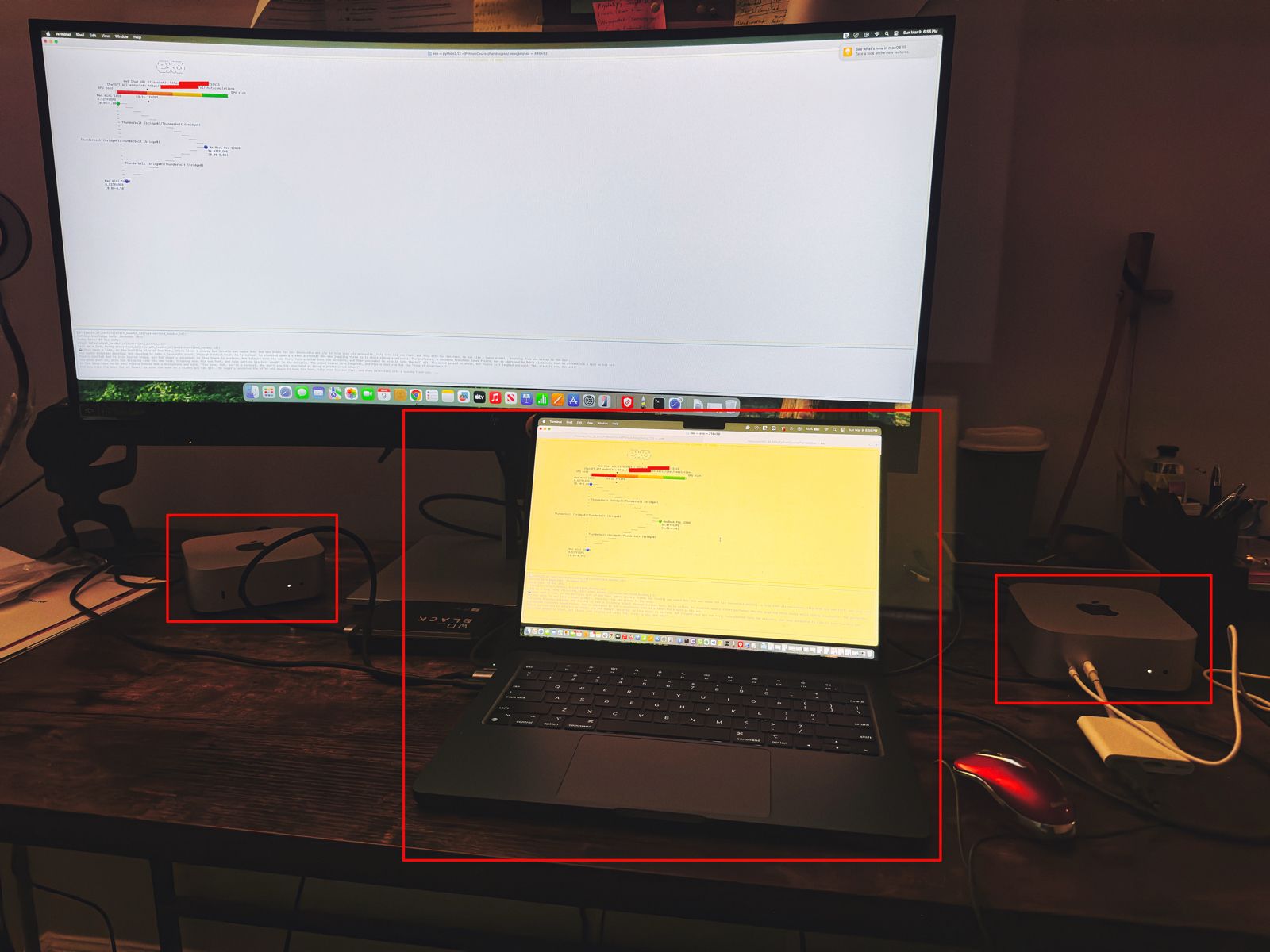
Let us understand the scenario. I’ve one Mac Book Pro M4 & 2 Mac Mini Pro M4 (Base models). So, I want to add them & expose them as a cluster as follows –
As you can see, I’ve connected my MacBook Pro with both the Mac Mini using high-speed thunderbolt cables for better data transmissions. And, I’ll be using an open-source framework called “Exo” to create it.
Also, you can see that my total computing capacity is 53.11 TFlops, which is slightly more than the last category.
What is Exo?
“Exo” is an open-source framework that helps you merge all your available devices into a large cluster of available resources. This extracts all the computing juice needed to handle complex tasks, including the big LLMs, which require very expensive GPU-based servers.
For more information on “Exo”, please refer to the following link.
In our previous diagram, we can see that the framework also offers endpoints.
One option is a local ChatGPT interface, where any question you ask will receive a response from models by combining all available computing power.
The other endpoint offers users a choice of any standard LLM API endpoint, which helps them integrate it into their solutions.
Let us see, how the devices are connected together –
How to establish the Cluster?
To proceed with this, you need to have at least Python 3.12, Anaconda or Miniconda & Xcode installed in all of your machines. Also, you need to install some Apple-specific MLX packages or libraries to get the best performance.
Depending on your choice, you need to use the following link to download Anaconda or Miniconda.
You can download the following link to download the Python 3.12. However, I’ve used Python 3.13 on some machines & some machines, I’ve used Python 3.12. And it worked without any problem.
Sometimes, after installing Anaconda or Miniconda, the environment may not implicitly be activated after successful installation. In that case, you may need to use the following commands in the terminal -> source ~/.bash_profile
To verify, whether the conda has been successfully installed & activated, you need to type the following command –
And, you need to perform the same process in other available devices as well.
Now, we’re ready to proceed with the final command –
(.venv) (exo1) satyaki_de@Satyakis-MacBook-Pro-Maxexo%exo/opt/anaconda3/envs/exo1/lib/python3.13/site-packages/google/protobuf/runtime_version.py:112: UserWarning:Protobufgencodeversion5.27.2isolderthantheruntimeversion5.28.1atnode_service.proto.Pleaseavoidchecked-inProtobufgencodethatcanbeobsolete.warnings.warn(NoneofPyTorch,TensorFlow>=2.0,orFlaxhavebeenfound.Modelswon't be available and only tokenizers, configuration and file/data utilities can be used.NoneofPyTorch,TensorFlow>=2.0,orFlaxhavebeenfound.Modelswon't be available and only tokenizers, configuration and file/data utilities can be used.Selectedinferenceengine: None__________/_ \ \//_ \ |__/>< (_) | \___/_/\_\___/Detectedsystem: AppleSiliconMacInferenceenginenameafterselection: mlxUsinginferenceengine: MLXDynamicShardInferenceEnginewithsharddownloader: SingletonShardDownloader[60771,54631,54661]Chatinterfacestarted:-http://127.0.0.1:52415-http://XXX.XXX.XX.XX:52415-http://XXX.XXX.XXX.XX:52415-http://XXX.XXX.XXX.XXX:52415ChatGPTAPIendpointservedat:-http://127.0.0.1:52415/v1/chat/completions-http://XXX.XXX.X.XX:52415/v1/chat/completions-http://XXX.XXX.XXX.XX:52415/v1/chat/completions-http://XXX.XXX.XXX.XXX:52415/v1/chat/completionshas_read=True,has_write=True╭────────────────────────────────────────────────────────────────────────────────────────────── ExoCluster (2nodes) ───────────────────────────────────────────────────────────────────────────────────────────────╮ReceivedexitsignalSIGTERM...Thankyouforusingexo.__________/_ \ \//_ \ |__/>< (_) | \___/_/\_\___/
Note that I’ve masked the IP addresses for security reasons.
Run Time:
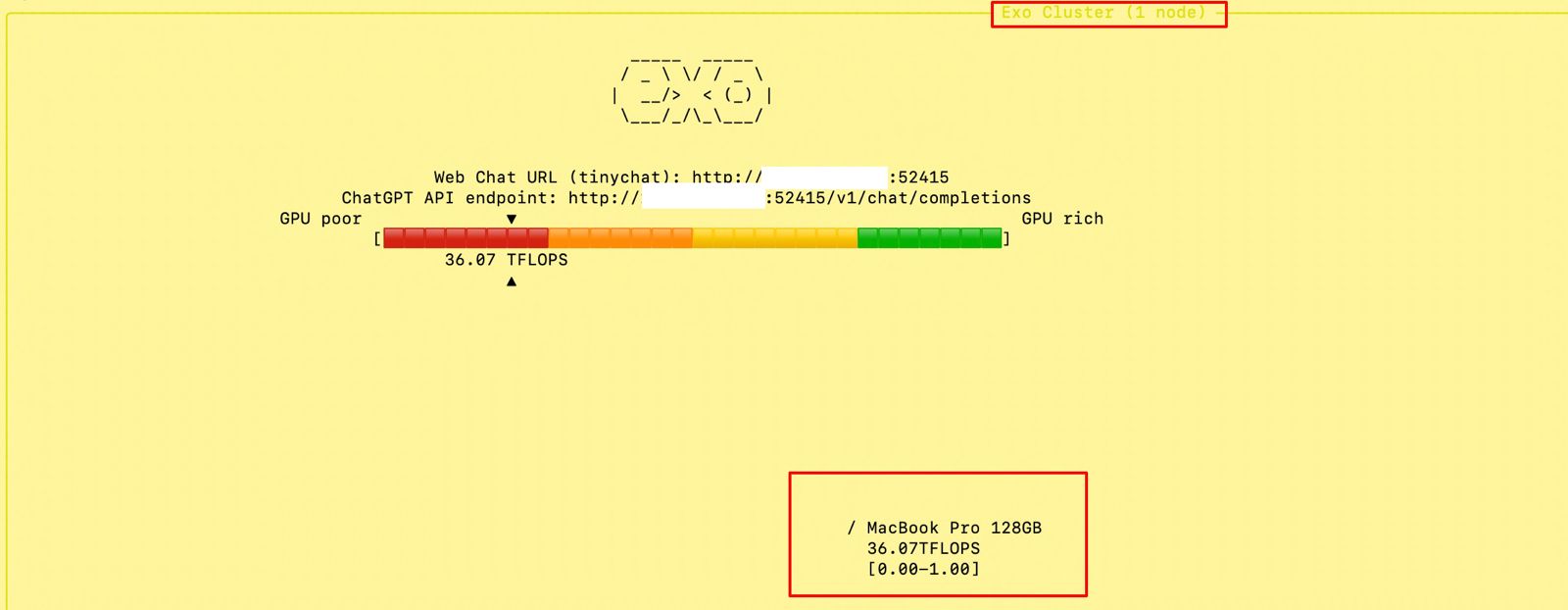
At the beginning, if we trigger the main MacBook Pro Max, the “Exo” screen should looks like this –
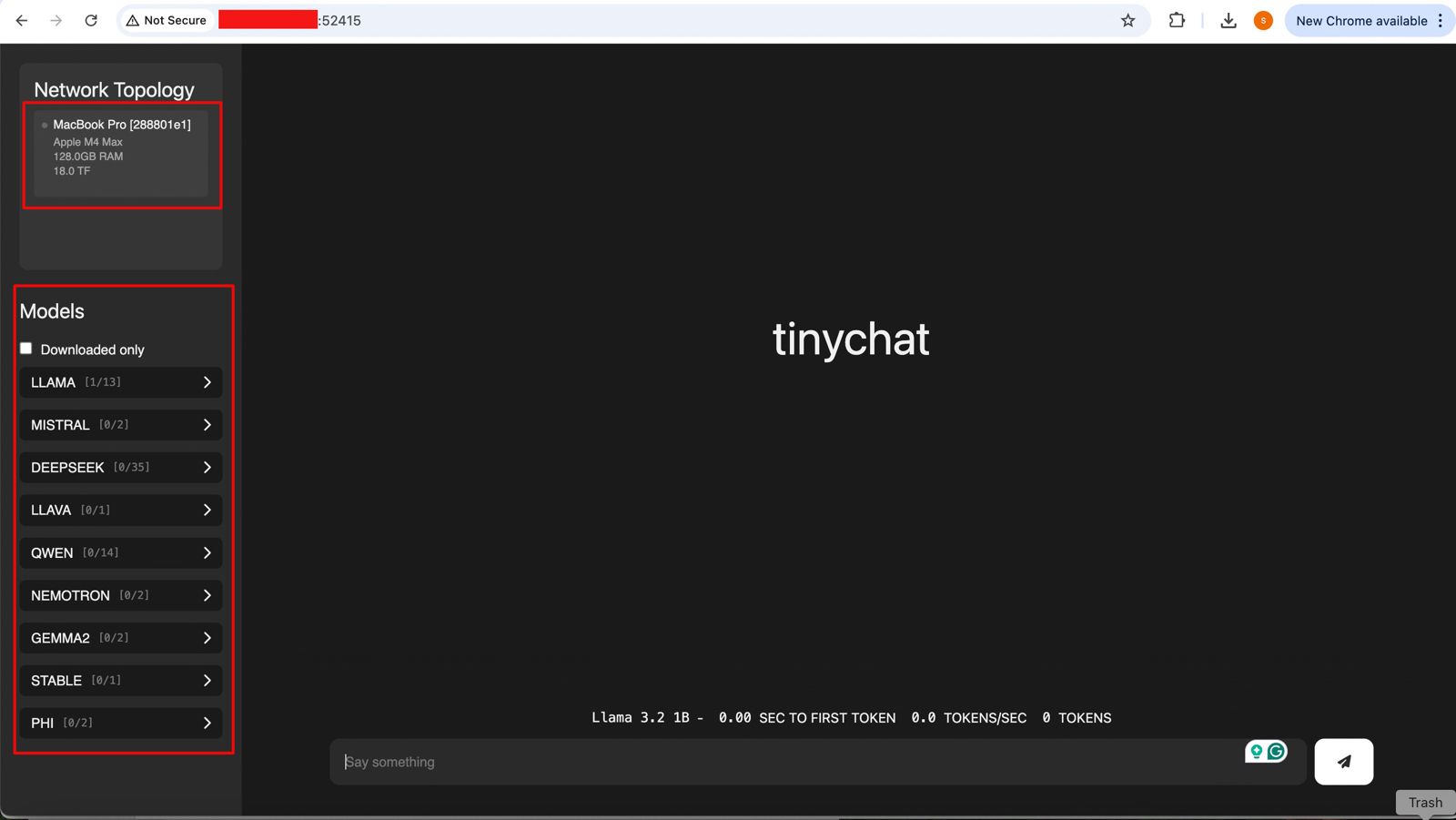
And if you open the URL, you will see the following ChatGPT-like interface –
Connecting without the Thunderbolt bridge with the relevant port or a hub may cause performance degradation. Hence, how you connect will play a major role in the success of this intention. However, this is certainly a great idea to proceed with.
So, we’ve done it.
We’ll cover the detailed performance testing, Optimized configurations & many other useful details in our next post.
Till then, Happy Avenging! 🙂
Note: All the data & scenarios posted here are representational data & scenarios & available over the internet & for educational purposes only. There is always room for improvement in this kind of model & the solution associated with it. I’ve shown the basic ways to achieve the same for educational purposes only.
How does the RAG work better for various enterprise-level Gen AI use cases? What needs to be there to make the LLM model work more efficiently & able to check the response & validate their response, including the bias, hallucination & many more?
This is my post (after a slight GAP), which will capture and discuss some of the burning issues that many AI architects are trying to explore. In this post, I’ve considered a newly formed AI start-up from India, which developed an open-source framework that can easily evaluate all the challenges that one is facing with their LLMs & easily integrate with your existing models for better understanding including its limitations. You will get plenty of insights about it.
But, before we dig deep, why not see the demo first –
Isn’t it exciting? Let’s deep dive into the flow of events.
Architecture:
Let’s explore the broad-level architecture/flow –
Let us understand the steps of the above architecture. First, our Python application needs to trigger and enable the API, which will interact with the Open AI and UpTrain AI to fetch all the LLM KPIs based on the input from the React app named “Evaluation.”
Once the response is received from UpTrain AI, the Python application then organizes the results in a better readable manner without changing the core details coming out from their APIs & then shares that back with the react interface.
Let’s examine the react app’s sample inputs to better understand the input that will be passed to the Python-based API solution, which is wrapper capability to call multiple APIs from the UpTrain & then accumulate them under one response by parsing the data & reorganizing the data with the help of Open AI & sharing that back.
Highlighted in RED are some of the critical inputs you need to provide to get most of the KPIs. And, here are the sample text inputs for your reference –
Q. Enter input question. A. What are the four largest moons of Jupiter? Q. Enter the context document. A. Jupiter, the largest planet in our solar system, boasts a fascinating array of moons. Among these, the four largest are collectively known as the Galilean moons, named after the renowned astronomer Galileo Galilei, who first observed them in 1610. These four moons, Io, Europa, Ganymede, and Callisto, hold significant scientific interest due to their unique characteristics and diverse geological features. Q. Enter LLM response. A. The four largest moons of Jupiter, known as the Galilean moons, are Io, Europa, Ganymede, and Marshmello. Q. Enter the persona response. A. strict and methodical teacher Q. Enter the guideline. A. Response shouldn’t contain any specific numbers Q. Enter the ground truth. A. The Jupiter is the largest & gaseous planet in the solar system. Q. Choose the evaluation method. A. llm
Once you fill in the App should look like this –
Once you fill in, the app should look like the below screenshot –
Package Installation:
Let us understand the sample packages that are required for this task.
1. app.py (This script will consume real-time streaming data coming out from a hosted API source using another popular third-party service named Ably. Ably mimics the pub sub-streaming concept, which might be extremely useful for any start-up. This will then translate into many meaningful KPIs in a streamlit-based dashboard app.)
Note that, we’re not going to discuss the entire script here. Only those parts are relevant. However, you can get the complete scripts in the GitHub repository.
This function will ask the supplied questions with contexts or it will supply the UpTrain results to summarize the JSON into more easily readable plain texts. For our test, we’ve used “gpt-3.5-turbo”.
The above methods initiate the model from UpTrain to get all the stats, which will be helpful for your LLM response. In this post, we’ve captured the following KPIs –
The above method parsed the initial data from UpTrain before sending it to OpenAI for a better summary without changing any text returned by it.
@app.route('/evaluate',methods=['POST'])defevaluate():data=request.jsonifnot data:return{jsonify({'error':'No data provided'}),400} # Extractinginputdataforprocessing (justanexampleofloggingreceiveddata)question=data.get('question','')context=data.get('context','')llmResponse=''personaResponse=data.get('personaResponse','')guideline=data.get('guideline','')groundTruth=data.get('groundTruth','')evaluationMethod=data.get('evaluationMethod','')print('question:')print(question)llmResponse=askFeluda(context,question)print('='*200)print('Response from Feluda::')print(llmResponse)print('='*200) # GettingContextLLMcLLM=evalContextRelevance(question,context,llmResponse,personaResponse)print('&'*200)print('cLLM:')print(cLLM)print(type(cLLM))print('&'*200)results=extractPrintedData(cLLM)print('JSON::')print(results)resJson=jsonify(results)returnresJson
The above function is the main method, which first receives all the input parameters from the react app & then invokes one-by-one functions to get the LLM response, and LLM performance & finally summarizes them before sending it to react-app.
For any other scripts, please refer to the above-mentioned GitHub link.
Run:
Let us see some of the screenshots of the test run –
So, we’ve done it.
I’ll bring some more exciting topics in the coming days from the Python verse.
Till then, Happy Avenging! 🙂
Note: All the data & scenarios posted here are representational data & scenarios & available over the internet & for educational purposes only. There is always room for improvement in this kind of model & the solution associated with it. I’ve shown the basic ways to achieve the same for educational purposes only.
This new solution will evaluate the power of Stable Defussion, which is created solutions as we progress & refine our prompt from scratch by using Stable Defussion & Python. This post opens new opportunities for IT companies & business start-ups looking to deliver solutions & have better performance compared to the paid version of Stable Defussion AI’s API performance. This project is for the advanced Python, Stable Defussion for data Science Newbies & AI evangelists.
In a series of posts, I’ll explain and focus on the Stable Defussion API and custom solution using the Python-based SDK of Stable Defussion.
But, before that, let us view the video that it generates from the prompt by using the third-party API:
Prompt to Video
And, let us understand the prompt that we supplied to create the above video –
Lighthouse on a cliff overlooking the ocean, dynamic ocean waves crashing against rocks, dramatic clouds moving across sky, photorealistic water movement, mist and ocean spray, wind-driven waves, atmospheric sky motion, natural fluid dynamics, realistic, detailed, 8k. Do not change the size & shape of the lighthouse & the field on top of which the Lighthouse built.
Isn’t it exciting?
However, I want to stress this point: the video generated by the Stable Defusion (Stability AI) API was able to partially apply the animation effect. Even though the animation applies to the cloud, It doesn’t apply the animation to the wave. But, I must admit, the quality of the video is quite good.
Let us understand the code and how we run the solution, and then we can try to understand its performance along with the other solutions later in the subsequent series.
As you know, we’re exploring the code base of the third-party API, which will actually execute a series of API calls that create a video out of the prompt.
CODE:
Let us understand some of the important snippet –
classclsStabilityAIAPI:def__init__(self, STABLE_DIFF_API_KEY, OUT_DIR_PATH, FILE_NM, VID_FILE_NM):self.STABLE_DIFF_API_KEY = STABLE_DIFF_API_KEYself.OUT_DIR_PATH = OUT_DIR_PATHself.FILE_NM = FILE_NMself.VID_FILE_NM = VID_FILE_NMdefdelFile(self, fileName):try: # Deletingtheintermediateimageos.remove(fileName)return 0 exceptExceptionase:x = str(e)print('Error: ', x)return 1defgenerateText2Image(self, inputDescription):try:STABLE_DIFF_API_KEY = self.STABLE_DIFF_API_KEYfullFileName = self.OUT_DIR_PATH + self.FILE_NMifSTABLE_DIFF_API_KEYisNone:raiseException("MissingStabilityAPIkey.")response = requests.post(f"{api_host}/v1/generation/{engine_id}/text-to-image",headers={"Content-Type":"application/json","Accept":"application/json","Authorization":f"Bearer {STABLE_DIFF_API_KEY}"},json={"text_prompts": [{"text":inputDescription}],"cfg_scale":7,"height":1024,"width":576,"samples":1,"steps":30,},)ifresponse.status_code!=200:raiseException("Non-200 response: "+str(response.text))data=response.json()fori,imageinenumerate(data["artifacts"]):withopen(fullFileName,"wb") as f:f.write(base64.b64decode(image["base64"])) returnfullFileNameexceptExceptionas e:x=str(e)print('Error: ',x)return'N/A'defimage2VideoPassOne(self,imgNameWithPath):try:STABLE_DIFF_API_KEY=self.STABLE_DIFF_API_KEYresponse=requests.post(f"https://api.stability.ai/v2beta/image-to-video",headers={"authorization":f"Bearer {STABLE_DIFF_API_KEY}"},files={"image":open(imgNameWithPath,"rb")},data={"seed":0,"cfg_scale":1.8,"motion_bucket_id":127}, )print('First Pass Response:')print(str(response.text))genID=response.json().get('id')returngenIDexceptExceptionas e:x=str(e)print('Error: ',x)return'N/A'defimage2VideoPassTwo(self,genId):try:generation_id=genIdSTABLE_DIFF_API_KEY=self.STABLE_DIFF_API_KEYfullVideoFileName=self.OUT_DIR_PATH+self.VID_FILE_NMresponse=requests.request("GET",f"https://api.stability.ai/v2beta/image-to-video/result/{generation_id}",headers={'accept':"video/*", # Use 'application/json' to receive base64 encoded JSON'authorization':f"Bearer {STABLE_DIFF_API_KEY}"},) print('Retrieve Status Code: ',str(response.status_code))ifresponse.status_code==202:print("Generation in-progress, try again in 10 seconds.")return5elifresponse.status_code==200:print("Generation complete!")withopen(fullVideoFileName,'wb') as file:file.write(response.content)print("Successfully Retrieved the video file!")return0else:raiseException(str(response.json()))exceptExceptionas e:x=str(e)print('Error: ',x)return1
Now, let us understand the code –
1. CLASS INSTANTIATION
This function is called when an object of the class is created. It initializes four properties:
STABLE_DIFF_API_KEY: the API key for Stability AI services.
OUT_DIR_PATH: the folder path to save files.
FILE_NM: the name of the generated image file.
VID_FILE_NM: the name of the generated video file.
2. delFile(fileName)
This function deletes a file specified by fileName.
If successful, it returns 0.
If an error occurs, it logs the error and returns 1.
3. generateText2Image(inputDescription)
This function generates an image based on a text description:
Sends a request to the Stability AI text-to-image endpoint using the API key.
Saves the resulting image to a file.
Returns the file’s path on success or 'N/A' if an error occurs.
4. image2VideoPassOne(imgNameWithPath)
This function uploads an image to create a video in its first phase:
Sends the image to Stability AI’s image-to-video endpoint.
Logs the response and extracts the id (generation ID) for the next phase.
Returns the id if successful or 'N/A' on failure.
5. image2VideoPassTwo(genId)
This function retrieves the video created in the second phase using the genId:
Checks the video generation status from the Stability AI endpoint.
If complete, saves the video file and returns 0.
If still processing, returns 5.
Logs and returns 1 for any errors.
As you can see, the code is pretty simple to understand & we’ve taken all the necessary actions in case of any unforeseen network issues or even if the video is not ready after our job submission in the following lines of the main calling script (generateText2VideoAPI.py) –
Please let me know your feedback after reviewing all the posts! 🙂
Note: All the data & scenarios posted here are representational data & scenarios & available over the internet & for educational purposes only. There is always room for improvement in this kind of model & the solution associated with it. I’ve shown the basic ways to achieve the same for educational purposes only.
Today, I will share a new post in a part series about creating end-end LLMs that feed source data with RAG implementation. I’ll also use OpenAI python-based SDK and Haystack embeddings in this case.
In this post, I’ve directly subscribed to OpenAI & I’m not using OpenAI from Azure. However, I’ll explore that in the future as well.
Before I explain the process to invoke this new library, why not view the demo first & then discuss it?
Demo
FLOW OF EVENTS:
Let us look at the flow diagram as it captures the sequence of events that unfold as part of the process.
As you can see, to enable this large & complex solution, we must first establish the capabilities to build applications powered by LLMs, Transformer models, vector search, and more. You can use state-of-the-art NLP models to perform question-answering, answer generation, semantic document search, or build tools capable of complex decision-making and query resolution. Hence, steps no. 1 & 2 showcased the data embedding & creating that informed repository. We’ll be discussing that in our second part.
Once you have the informed repository, the system can interact with the end-users. As part of the query (shown in step 3), the prompt & the question are shared with the process engine, which then turned to reduce the volume & get relevant context from our informed repository & get the tuned context as part of the response (Shown in steps 4, 5 & 6).
Then, this tuned context is shared with the OpenAI for better response & summary & concluding remarks that are very user-friendly & easier to understand for end-users (Shown in steps 8 & 9).
IMPORTANT PACKAGES:
The following are the important packages that are essential to this project –
Let us understand some of the important sections of the above script –
Function – login():
The login function retrieves a ‘username’ and ‘password’ from a JSON request and prints them. It checks if the provided credentials are missing from users or password lists, returning a failure JSON response if so. It creates and returns an access token in a JSON response if valid.
Function – get_chat():
The get_chat function retrieves the running session count and user input from a JSON request. Based on the session count, it extracts catalog data or processes the user’s message from the RAG framework that finally receives the refined response from the OpenAI, extracting hash values, image URLs, and wiki URLs. If an error arises, the function captures and returns the error as a JSON message.
Function – updateCounter():
The updateCounter function checks if a given CSV file exists and retrieves its counter value. It then increments the counter and writes it back to the CSV. If any errors occur, an error message is printed, and the function returns a value of 1.
Function – extractRemoveUrls():
The extractRemoveUrls function attempts to filter a data frame, resDf, based on a provided hash value to extract image and wiki URLs. If the data frame contains matching entries, it retrieves the corresponding URLs. Any errors encountered are printed, but the function always returns the image and wiki URLs, even if they are empty.
clsContentScrapper.py (This is the main class that brings the default options for the users if they agree with the initial prompt by the bot.)
Let us understand the the core part that require from this class.
Function – extractCatalog():
The extractCatalog function uses specific headers to make a GET request to a constructed URL. The URL is derived by appending ‘/departments’ to a base_url, and a header token is used in the request headers. If successful, it returns the text of the response; if there’s an exception, it prints the error and returns the error message.
clsRAGOpenAI.py (This is the main class that brings the RAG-enabled context that is fed to OpenAI for fine-tuned response with less cost.)
############################################################# Written By:SATYAKIDE ######## Written On:27-Jun-2023 ######## ModifiedOn28-Jun-2023 ######## ######## Objective:Thisisthemaincalling ######## pythonscriptthatwillinvokethe ######## shortcutapplicationcreatedinsideMAC ######## enviornmentincludingMacBook,IPadorIPhone. ######## #############################################################fromhaystack.document_stores.faissimportFAISSDocumentStorefromhaystack.nodesimportDensePassageRetrieverimportopenaifromclsConfigClientimportclsConfigClientascfimportclsLaslog# DisblingWarningdefwarn(*args,**kwargs):passimportwarningswarnings.warn = warnimportosimportre################################################## GlobalSection ##################################################Ind = cf.conf['DEBUG_IND']queryModel = cf.conf['QUERY_MODEL']passageModel = cf.conf['PASSAGE_MODEL']#InitiatingLoggingInstancesclog = log.clsL()os.environ["TOKENIZERS_PARALLELISM"] = "false"vectorDBFileName = cf.conf['VECTORDB_FILE_NM']indexFile = "vectorDB/" + str(vectorDBFileName) + '.faiss'indexConfig = "vectorDB/" + str(vectorDBFileName) + ".json"print('File: ',str(indexFile))print('Config: ',str(indexConfig))# Also,provide`config_path`parameterifyousetitwhencallingthe`save()`method:new_document_store = FAISSDocumentStore.load(index_path=indexFile,config_path=indexConfig)# InitializeRetrieverretriever = DensePassageRetriever(document_store=new_document_store,query_embedding_model=queryModel,passage_embedding_model=passageModel,use_gpu=False)################################################## EndofGlobalSection ##################################################classclsRAGOpenAI:def__init__(self):self.basePath = cf.conf['DATA_PATH']self.fileName = cf.conf['FILE_NAME']self.Ind = cf.conf['DEBUG_IND']self.subdir = str(cf.conf['OUT_DIR'])self.base_url = cf.conf['BASE_URL']self.outputPath = cf.conf['OUTPUT_PATH']self.vectorDBPath = cf.conf['VECTORDB_PATH']self.openAIKey = cf.conf['OPEN_AI_KEY']self.temp = cf.conf['TEMP_VAL']self.modelName = cf.conf['MODEL_NAME']self.maxToken = cf.conf['MAX_TOKEN']defextractHash(self,text):try: # Regularexpressionpatterntomatch'Ref: {'followedbyanumberandthen'}'pattern = r"Ref: \{'(\d+)'\}"match = re.search(pattern,text)ifmatch:returnmatch.group(1)else:returnNoneexceptExceptionase:x = str(e)print('Error: ',x)returnNonedefremoveSentencesWithNaN(self,text):try: # Splittextintosentencesusingregularexpressionsentences = re.split('(?<!\w\.\w.)(?<![A-Z][a-z]\.)(?<=\.|\?)\s',text) # Filteroutsentencescontaining'nan'filteredSentences = [sentenceforsentenceinsentencesif'nan'notinsentence] # Rejointhesentencesreturn''.join(filteredSentences)exceptExceptionase:x = str(e)print('Error: ',x)return''defretrieveDocumentsReader(self,question,top_k=9):returnretriever.retrieve(question,top_k=top_k)defgenerateAnswerWithGPT3(self,retrieved_docs,question):try:openai.api_key = self.openAIKeytemp = self.tempmodelName = self.modelNamemaxToken = self.maxTokendocumentsText = "".join([doc.contentfordocinretrieved_docs])filteredDocs = self.removeSentencesWithNaN(documentsText)hashValue = self.extractHash(filteredDocs)print('RAG Docs:: ')print(filteredDocs) #prompt = f"Given the following documents: {documentsText}, answer the question accurately based on the above data with the supplied http urls: {question}" # Setupachat-stylepromptwithyourdatamessages = [{"role": "system", "content": "Youareahelpfulassistant,answerthequestionaccuratelybasedontheabovedatawiththesuppliedhttpurls. Onlyrelevantcontentneedstopublish. Pleasedonotprovidethefactsorthetextsthatresultscrossingthemax_tokenlimits."},{"role": "user", "content": filteredDocs} ] # Chatstyleinvokingthelatestmodelresponse = openai.ChatCompletion.create(model=modelName,messages=messages,temperature = temp,max_tokens=maxToken )returnhashValue,response.choices[0].message['content'].strip().replace('\n','\\n')exceptExceptionase:x = str(e)print('failed to get from OpenAI: ',x)return'Not Available!'defragAnswerWithHaystackAndGPT3(self,question):retrievedDocs = self.retrieveDocumentsReader(question)returnself.generateAnswerWithGPT3(retrievedDocs,question)defgetData(self,strVal):try:print('*'*120)print('Index Your Data for Retrieval:')print('*'*120)print('Response from New Docs: ')print()hashValue,answer = self.ragAnswerWithHaystackAndGPT3(strVal)print('GPT3 Answer::')print(answer)print('Hash Value:')print(str(hashValue))print('*'*240)print('End Of Use RAG to Generate Answers:')print('*'*240)returnhashValue,answerexceptExceptionase:x = str(e)print('Error: ',x)answer = xhashValue = 1returnhashValue,answer
Let us understand some of the important block –
Function – ragAnswerWithHaystackAndGPT3():
The ragAnswerWithHaystackAndGPT3 function retrieves relevant documents for a given question using the retrieveDocumentsReader method. It then generates an answer for the query using GPT-3 with the retrieved documents via the generateAnswerWithGPT3 method. The final response is returned.
Function – generateAnswerWithGPT3():
The generateAnswerWithGPT3 function, given a list of retrieved documents and a question, communicates with OpenAI’s GPT-3 to generate an answer. It first processes the documents, filtering and extracting a hash value. Using a chat-style format, it prompts GPT-3 with the processed documents and captures its response. If an error occurs, an error message is printed, and “Not Available!” is returned.
Function – retrieveDocumentsReader():
The retrieveDocumentsReader function takes in a question and an optional parameter, top_k (defaulted to 9). It is called the retriever.retrieve method with the given parameters. The result of the retrieval will generate at max nine responses from the RAG engine, which will be fed to OpenAI.
React:
App.js (This is the main react script, that will create the interface & parse the data apart from the authentication)
// App.jsimportReact,{useState}from'react';importaxiosfrom'axios';import'./App.css';constApp=()=>{const[isLoggedIn,setIsLoggedIn]=useState(false);const[username,setUsername]=useState('');const[password,setPassword]=useState('');const[message,setMessage]=useState('');const[chatLog,setChatLog]=useState([{sender:'MuBot',message:'Welcome to MuBot! Please explore the world of History from our brilliant collections! Do you want to proceed to see the catalog?'}]);consthandleLogin=async(e)=>{e.preventDefault();try{constresponse=awaitaxios.post('http://localhost:5000/login',{username,password});if (response.status===200) {setIsLoggedIn(true);}}catch (error) {console.error('Login error:',error);}};constsendMessage=async(username)=>{if (message.trim() ==='') return;// Create a new chat entryconstnewChatEntry={sender:'user',message:message.trim(),};// Clear the input fieldsetMessage('');try{// Make API request to Python-based APIconstresponse=awaitaxios.post('http://localhost:5000/chat',{message:newChatEntry.message});// Replace with your API endpoint URLconstresponseData=response.data;// Print the response to the console for debuggingconsole.log('API Response:',responseData);// Parse the nested JSON from the 'message' attributeconstjsonData=JSON.parse(responseData.message);// Check if the data contains 'departments'if (jsonData.departments) {// Extract the 'departments' attribute from the parsed dataconstdepartments=jsonData.departments;// Extract the department names and create a single string with line breaksconstbotResponseText=departments.reduce((acc,department)=>{returnacc+department.departmentId+''+department.displayName+'\n';},'');// Update the chat log with the bot's responsesetChatLog((prevChatLog)=> [...prevChatLog,{sender:'user',message:message},{sender:'bot',message:botResponseText},]);}elseif (jsonData.records){// Data structure 2: Artwork informationconstrecords=jsonData.records;// Prepare chat entriesconstchatEntries= [];// Iterate through records and extract text, image, and wiki informationrecords.forEach((record)=>{consttextInfo=Object.entries(record).map(([key,value])=>{if (key!=='Image'&&key!=='Wiki') {return`${key}: ${value}`;}returnnull;}).filter((info)=>info!==null).join('\n');constimageLink=record.Image;//const wikiLinks = JSON.parse(record.Wiki.replace(/'/g, '"'));//const wikiLinks = record.Wiki;constwikiLinks=record.Wiki.split(',').map(link=>link.trim());console.log('Wiki:',wikiLinks);// Check if there is a valid image linkconsthasValidImage=imageLink&&imageLink!=='[]';constimageElement=hasValidImage? (<imgsrc={imageLink}alt="Artwork"style={{maxWidth:'100%'}}/> ) :null;// Create JSX elements for rendering the wiki links (if available)constwikiElements=wikiLinks.map((link,index)=> (<divkey={index}><ahref={link}target="_blank"rel="noopener noreferrer"> Wiki Link {index+1}</a></div> ));if (textInfo) {chatEntries.push({sender:'bot',message:textInfo});}if (imageElement) {chatEntries.push({sender:'bot',message:imageElement});}if (wikiElements.length >0) {chatEntries.push({sender:'bot',message:wikiElements});}});// Update the chat log with the bot's responsesetChatLog((prevChatLog)=> [...prevChatLog,{sender:'user',message},...chatEntries, ]);}}catch (error) {console.error('Error sending message:',error);}};if (!isLoggedIn) {return (<divclassName="login-container"><h2>Welcome to the MuBot</h2><formonSubmit={handleLogin}className="login-form"><inputtype="text"placeholder="Enter your name"value={username}onChange={(e)=>setUsername(e.target.value)}required/><inputtype="password"placeholder="Enter your password"value={password}onChange={(e)=>setPassword(e.target.value)}required/><buttontype="submit">Login</button></form></div> );}return (<divclassName="chat-container"><divclassName="chat-header"><h2>Hello, {username}</h2><h3>Chat with MuBot</h3></div><divclassName="chat-log">{chatLog.map((chatEntry,index)=> (<divkey={index}className={`chat-entry ${chatEntry.sender==='user'?'user':'bot'}`}><spanclassName="user-name">{chatEntry.sender==='user'?username:'MuBot'}</span><pclassName="chat-message">{chatEntry.message}</p></div> ))}</div><divclassName="chat-input"><inputtype="text"placeholder="Type your message..."value={message}onChange={(e)=>setMessage(e.target.value)}onKeyPress={(e)=>{if (e.key==='Enter') {sendMessage();}}}/><buttononClick={sendMessage}>Send</button></div></div> );};exportdefaultApp;
Please find some of the important logic –
Function – handleLogin():
The handleLogin asynchronous function responds to an event by preventing its default action. It attempts to post a login request with a username and password to a local server endpoint. If the response is successful with a status of 200, it updates a state variable to indicate a successful login; otherwise, it logs any encountered errors.
Function – sendMessage():
The sendMessage asynchronous function is designed to handle the user’s chat interaction:
If the message is empty (after trimming spaces), the function exits without further action.
A chat entry object is created with the sender set as ‘user’ and the trimmed message.
The input field’s message is cleared, and an API request is made to a local server endpoint with the chat message.
If the API responds with a ‘departments’ attribute in its JSON, a bot response is crafted by iterating over department details.
If the API responds with ‘records’ indicating artwork information, the bot crafts responses for each record, extracting text, images, and wiki links, and generating JSX elements for rendering them.
After processing the API response, the chat log state is updated with the user’s original message and the bot’s responses.
Errors, if encountered, are logged to the console.
This function enables interactive chat with bot responses that vary based on the nature of the data received from the API.
DIRECTORY STRUCTURES:
Let us explore the directory structure starting from the parent to some of the important child folder should look like this –
So, finally, we’ve done it.
I know that this post is relatively bigger than my earlier post. But, I think, you can get all the details once you go through it.
You will get the complete codebase in the following GitHub link.
I’ll bring some more exciting topics in the coming days from the Python verse. Please share & subscribe to my post & let me know your feedback.
Till then, Happy Avenging! 🙂
Note: All the data & scenarios posted here are representational data & scenarios & available over the internet & for educational purposes only. Some of the images (except my photo) we’ve used are available over the net. We don’t claim ownership of these images. There is always room for improvement & especially in the prediction quality.





You must be logged in to post a comment.