Real-time video summary assistance App – Part 1

Today, we’ll discuss another topic in our two-part series. We will understand the importance of the MCP protocol for communicating between agents.

This will be an in-depth highly technical as well as depicting using easy-to-understand visuals.

But, before that, let us understand the demo first.

Isn’t it exciting?


Let us first understand in easy language about the MCP protocol.

MCP (Multi-Agent Communication Protocol) is a custom message exchange system that facilitates structured and scalable communication among multiple AI agents operating within an application. These agents collaborate asynchronously or in real-time to complete complex tasks by sharing results, context, and commands through a common messaging layer.

How MCP Protocol Helps:

FeatureBenefit
Agent-Oriented ArchitectureEach agent handles a focused task, improving modularity and scalability.
Event-Driven Message PassingAgents communicate based on triggers, not polling—leading to faster and efficient responses.
Structured Communication FormatAll messages follow a standard format (e.g., JSON) with metadata for sender, recipient, type, and payload.
State PreservationAgents maintain context across messages using memory (e.g., ConversationBufferMemory) to ensure coherence.

How It Works (Step-by-Step):

  • 📥 User uploads or streams a video.
  • 🧑‍💻 MCP Protocol triggers the Transcription Agent to start converting audio into text.
  • 🌐 Translation Agent receives this text (if a different language is needed).
  • 🧾 Summarization Agent receives the translated or original transcript and generates a concise summary.
  • 📚 Research Agent checks for references or terminology used in the video.
  • 📄 Documentation Agent compiles the output into a structured report.
  • 🔁 All communication between agents flows through MCP, ensuring consistent message delivery and coordination.

Now, let us understand the solution that we intend to implement for our solutions:

This app provides live summarization and contextual insights from videos such as webinars, interviews, or YouTube recordings using multiple cooperating AI agents. These agents may include:

  • Transcription Agent: Converts spoken words to text.
  • Translation Agent: Translates text to different languages (if needed).
  • Summarization Agent: Generates concise summaries.
  • Research Agent: Finds background or supplementary data related to the discussion.
  • Documentation Agent: Converts outputs into structured reports or learning materials.

We need to understand one more thing before deep diving into the code. Part of your conversation may be mixed, like part Hindi & part English. So, in that case, it will break the sentences into chunks & then convert all of them into the same language. Hence, the following rules are applied while translating the sentences –


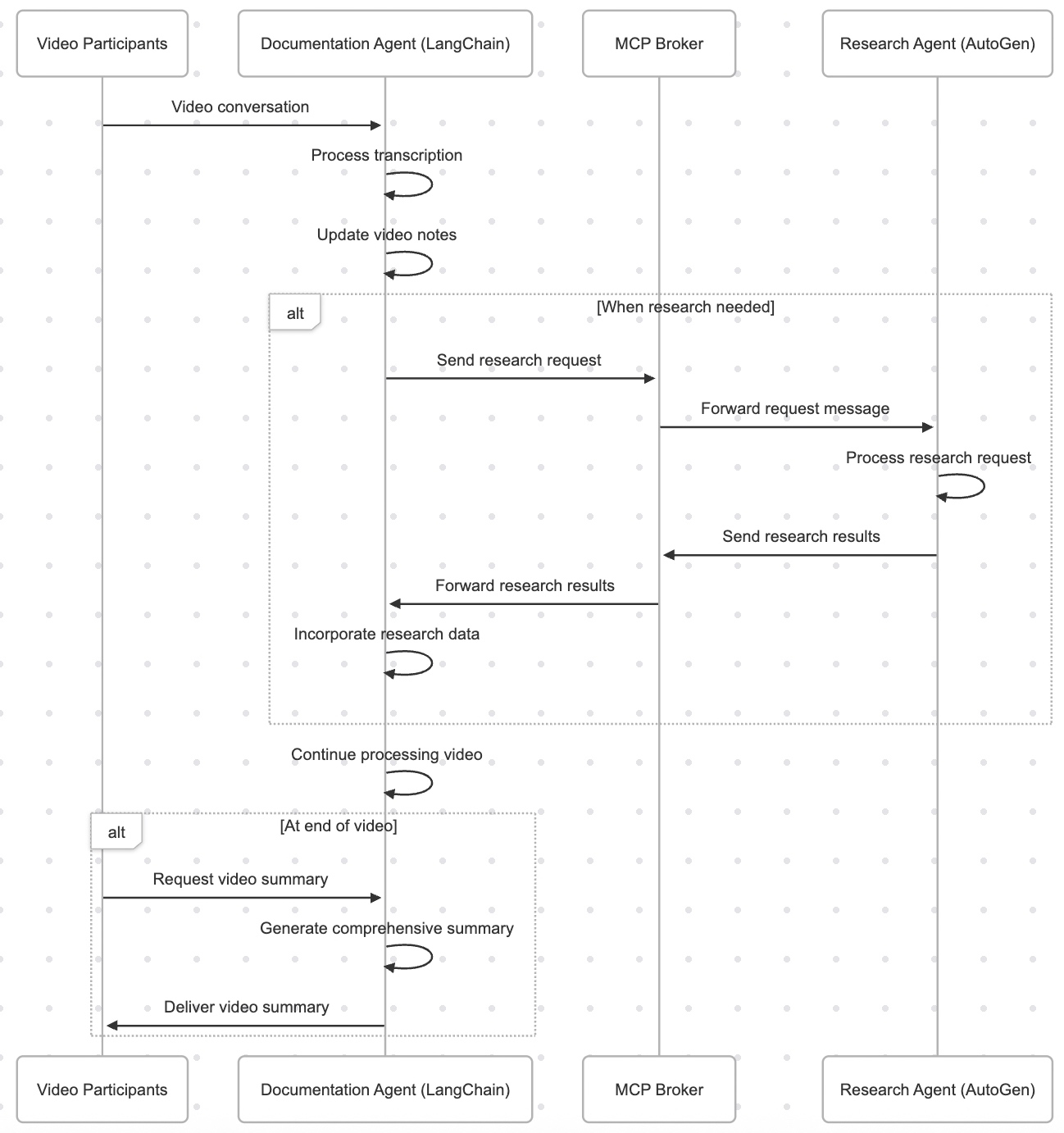
Now, we will go through the basic frame of the system & try to understand how it fits all the principles that we discussed above for this particular solution mapped against the specific technology –

  1. Documentation Agent built with the LangChain framework
  2. Research Agent built with the AutoGen framework
  3. MCP Broker for seamless communication between agents

Let us understand from the given picture the flow of the process that our app is trying to implement –


Great! So, now, we’ll focus on some of the key Python scripts & go through their key features.

But, before that, we share the group of scripts that belong to specific tasks.

  • clsMCPMessage.py
  • clsMCPBroker.py
  • clsYouTubeVideoProcessor.py
  • clsLanguageDetector.py
  • clsTranslationAgent.py
  • clsTranslationService.py
  • clsDocumentationAgent.py
  • clsResearchAgent.py

Now, we’ll review some of the script in this post, along with the next post, as a continuation from this post.

class clsMCPMessage(BaseModel):
    """Message format for MCP protocol"""
    id: str = Field(default_factory=lambda: str(uuid.uuid4()))
    timestamp: float = Field(default_factory=time.time)
    sender: str
    receiver: str
    message_type: str  # "request", "response", "notification"
    content: Dict[str, Any]
    reply_to: Optional[str] = None
    conversation_id: str
    metadata: Dict[str, Any] = {}
    
class clsMCPBroker:
    """Message broker for MCP protocol communication between agents"""
    
    def __init__(self):
        self.message_queues: Dict[str, queue.Queue] = {}
        self.subscribers: Dict[str, List[str]] = {}
        self.conversation_history: Dict[str, List[clsMCPMessage]] = {}
    
    def register_agent(self, agent_id: str) -> None:
        """Register an agent with the broker"""
        if agent_id not in self.message_queues:
            self.message_queues[agent_id] = queue.Queue()
            self.subscribers[agent_id] = []
    
    def subscribe(self, subscriber_id: str, publisher_id: str) -> None:
        """Subscribe an agent to messages from another agent"""
        if publisher_id in self.subscribers:
            if subscriber_id not in self.subscribers[publisher_id]:
                self.subscribers[publisher_id].append(subscriber_id)
    
    def publish(self, message: clsMCPMessage) -> None:
        """Publish a message to its intended receiver"""
        # Store in conversation history
        if message.conversation_id not in self.conversation_history:
            self.conversation_history[message.conversation_id] = []
        self.conversation_history[message.conversation_id].append(message)
        
        # Deliver to direct receiver
        if message.receiver in self.message_queues:
            self.message_queues[message.receiver].put(message)
        
        # Deliver to subscribers of the sender
        for subscriber in self.subscribers.get(message.sender, []):
            if subscriber != message.receiver:  # Avoid duplicates
                self.message_queues[subscriber].put(message)
    
    def get_message(self, agent_id: str, timeout: Optional[float] = None) -> Optional[clsMCPMessage]:
        """Get a message for the specified agent"""
        try:
            return self.message_queues[agent_id].get(timeout=timeout)
        except (queue.Empty, KeyError):
            return None
    
    def get_conversation_history(self, conversation_id: str) -> List[clsMCPMessage]:
        """Get the history of a conversation"""
        return self.conversation_history.get(conversation_id, [])

Imagine a system where different virtual agents (like robots or apps) need to talk to each other. To do that, they send messages back and forth—kind of like emails or text messages. This code is responsible for:

  • Making sure those messages are properly written (like filling out all parts of a form).
  • Making sure messages are delivered to the right people.
  • Keeping a record of conversations so you can go back and review what was said.

This part (clsMCPMessage) is like a template or a form that every message needs to follow. Each message has:

  • ID: A unique number so every message is different (like a serial number).
  • Time Sent: When the message was created.
  • Sender & Receiver: Who sent the message and who is supposed to receive it.
  • Type of Message: Is it a request, a response, or just a notification?
  • Content: The actual information or question the message is about.
  • Reply To: If this message is answering another one, this tells which one.
  • Conversation ID: So we know which group of messages belongs to the same conversation.
  • Extra Info (Metadata): Any other small details that might help explain the message.

This (clsMCPBroker) is the system (or “post office”) that makes sure messages get to where they’re supposed to go. Here’s what it does:

1. Registering an Agent

  • Think of this like signing up a new user in the system.
  • Each agent gets their own personal mailbox (called a “message queue”) so others can send them messages.

2. Subscribing to Another Agent

  • If Agent A wants to receive copies of messages from Agent B, they can “subscribe” to B.
  • This is like signing up for B’s newsletter—whenever B sends something, A gets a copy.

3. Sending a Message

  • When someone sends a message:
    • It is saved into a conversation history (like keeping emails in your inbox).
    • It is delivered to the main person it was meant for.
    • And, if anyone subscribed to the sender, they get a copy too—unless they’re already the main receiver (to avoid sending duplicates).

4. Receiving Messages

  • Each agent can check their personal mailbox to see if they got any new messages.
  • If there are no messages, they’ll either wait for some time or move on.

5. Viewing Past Conversations

  • You can look up all messages that were part of a specific conversation.
  • This is helpful for remembering what was said earlier.

In systems where many different smart tools or services need to work together and communicate, this kind of communication system makes sure everything is:

  • Organized
  • Delivered correctly
  • Easy to trace back when needed

So, in this post, we’ll finish it here. We’ll cover the rest of the post in the next post.

I’ll bring some more exciting topics in the coming days from the Python verse.

Till then, Happy Avenging!  🙂

Creating a local LLM Cluster Server using Apple Silicon GPU

Today, we’re going to discuss creating a local LLM server and then utilizing it to execute various popular LLM models. We will club the local Apple GPUs together via a new framework that binds all the available Apple Silicon devices into one big LLM server. This enables people to run many large models, which was otherwise not possible due to the lack of GPUs.

This is certainly a new way; One can create virtual computation layers by adding nodes to the resource pool, increasing the computation capacity.

Why not witness a small demo to energize ourselves –

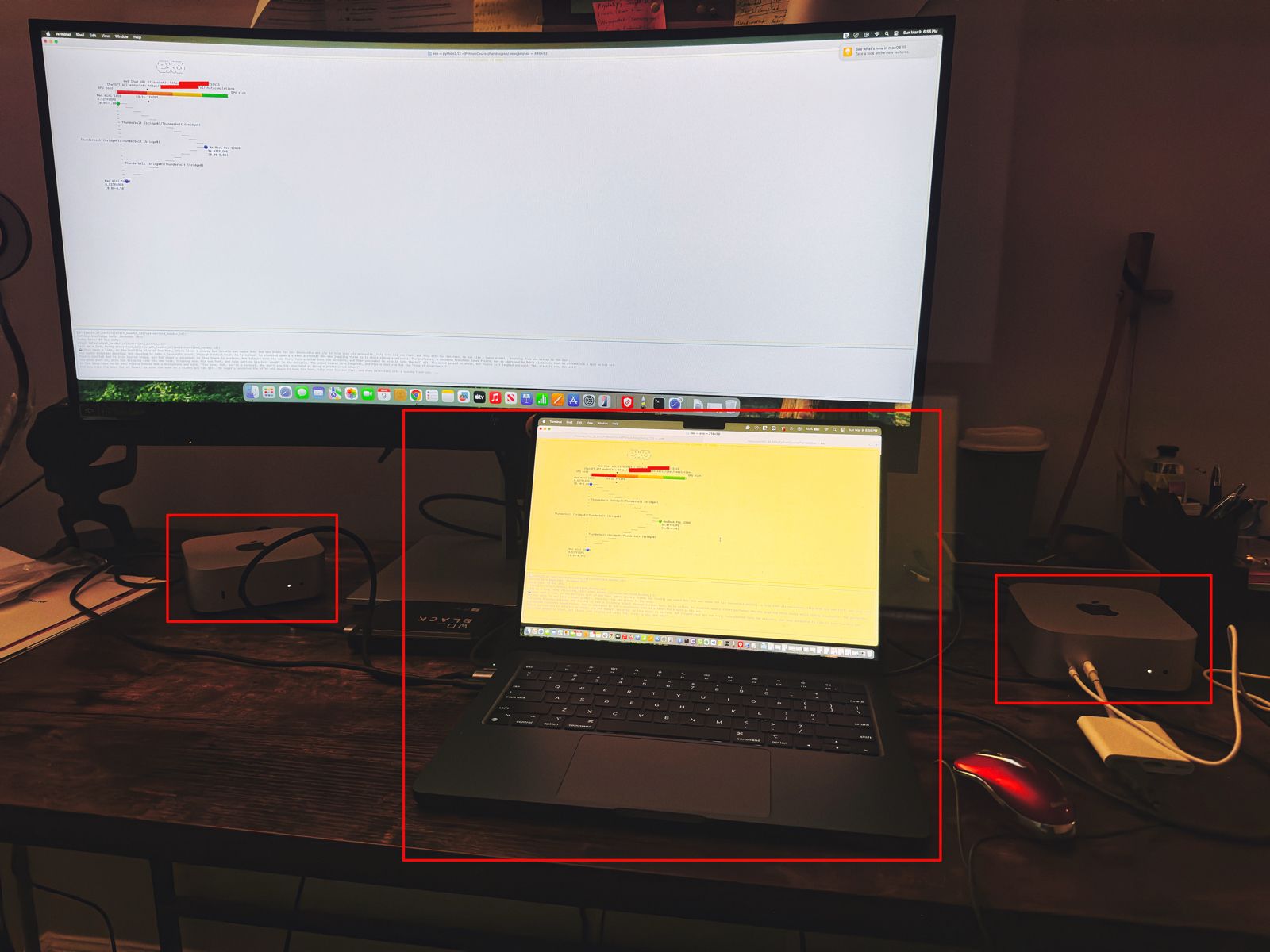
Let us understand the scenario. I’ve one Mac Book Pro M4 & 2 Mac Mini Pro M4 (Base models). So, I want to add them & expose them as a cluster as follows –

As you can see, I’ve connected my MacBook Pro with both the Mac Mini using high-speed thunderbolt cables for better data transmissions. And, I’ll be using an open-source framework called “Exo” to create it.

Also, you can see that my total computing capacity is 53.11 TFlops, which is slightly more than the last category.

“Exo” is an open-source framework that helps you merge all your available devices into a large cluster of available resources. This extracts all the computing juice needed to handle complex tasks, including the big LLMs, which require very expensive GPU-based servers.

For more information on “Exo”, please refer to the following link.

In our previous diagram, we can see that the framework also offers endpoints.

  • One option is a local ChatGPT interface, where any question you ask will receive a response from models by combining all available computing power.
  • The other endpoint offers users a choice of any standard LLM API endpoint, which helps them integrate it into their solutions.

Let us see, how the devices are connected together –


To proceed with this, you need to have at least Python 3.12, Anaconda or Miniconda & Xcode installed in all of your machines. Also, you need to install some Apple-specific MLX packages or libraries to get the best performance.

Depending on your choice, you need to use the following link to download Anaconda or Miniconda.

You can download the following link to download the Python 3.12. However, I’ve used Python 3.13 on some machines & some machines, I’ve used Python 3.12. And it worked without any problem.

Sometimes, after installing Anaconda or Miniconda, the environment may not implicitly be activated after successful installation. In that case, you may need to use the following commands in the terminal -> source ~/.bash_profile

To verify, whether the conda has been successfully installed & activated, you need to type the following command –

(base) satyaki_de@Satyakis-MacBook-Pro-Max Pandas % conda --version
conda 24.11.3
(base) satyaki_de@Satyakis-MacBook-Pro-Max Pandas % 

Once you verify it. Now, we need to install the following supplemental packages in all the machines as –

satyaki_de@Satyakis-MacBook-Pro-Max Pandas % 
satyaki_de@Satyakis-MacBook-Pro-Max Pandas % conda install anaconda::m4
Channels:
 - defaults
 - anaconda
Platform: osx-arm64
Collecting package metadata (repodata.json): done
Solving environment: done

## Package Plan ##

  environment location: /opt/anaconda3

  added / updated specs:
    - anaconda::m4


The following packages will be downloaded:

    package                    |            build
    ---------------------------|-----------------
    m4-1.4.18                  |       h1230e6a_1         202 KB  anaconda
    ------------------------------------------------------------
                                           Total:         202 KB

The following NEW packages will be INSTALLED:

  m4                 anaconda/osx-arm64::m4-1.4.18-h1230e6a_1 


Proceed ([y]/n)? y


Downloading and Extracting Packages:
                                                                                                                                                                                                                      
Preparing transaction: done
Verifying transaction: done
Executing transaction: done

Also, you can use this package to install in your machines –

(base) satyakidemini2@Satyakis-Mac-mini-2 exo % 
(base) satyakidemini2@Satyakis-Mac-mini-2 exo % pip install mlx
Collecting mlx
  Downloading mlx-0.23.2-cp312-cp312-macosx_14_0_arm64.whl.metadata (5.3 kB)
Downloading mlx-0.23.2-cp312-cp312-macosx_14_0_arm64.whl (27.6 MB)
   ━━━━━━━━━━━━━━━━━━━━━━━━━━━━━━━━━━━━━━━━ 27.6/27.6 MB 8.8 MB/s eta 0:00:00
Installing collected packages: mlx
Successfully installed mlx-0.23.2
(base) satyakidemini2@Satyakis-Mac-mini-2 exo % 

Till now, we’ve installed all the important packages. Now, we need to setup the final “eco” framework in all the machines like our previous steps.

Now, we’ll first clone the “eco” framework by the following commands –

(base) satyaki_de@Satyakis-MacBook-Pro-Max Pandas % 
(base) satyaki_de@Satyakis-MacBook-Pro-Max Pandas % git clone https://github.com/exo-explore/exo.git
Cloning into 'exo'...
remote: Enumerating objects: 9736, done.
remote: Counting objects: 100% (411/411), done.
remote: Compressing objects: 100% (148/148), done.
remote: Total 9736 (delta 333), reused 263 (delta 263), pack-reused 9325 (from 3)
Receiving objects: 100% (9736/9736), 12.18 MiB | 8.41 MiB/s, done.
Resolving deltas: 100% (5917/5917), done.
Updating files: 100% (178/178), done.
Filtering content: 100% (9/9), 3.16 MiB | 2.45 MiB/s, done.
(base) satyaki_de@Satyakis-MacBook-Pro-Max Pandas % 

And, the content of the “Exo” folder should look like this –

total 28672
drwx------  1 satyaki_de  staff  1048576 Mar  9 17:06 docs
-rwx------  1 satyaki_de  staff     1337 Mar  9 17:06 configure_mlx.sh
-rwx------  1 satyaki_de  staff    11107 Mar  9 17:06 README.md
-rwx------  1 satyaki_de  staff    35150 Mar  9 17:06 LICENSE
drwx------  1 satyaki_de  staff  1048576 Mar  9 17:06 examples
drwx------  1 satyaki_de  staff  1048576 Mar  9 17:06 exo
drwx------  1 satyaki_de  staff  1048576 Mar  9 17:06 extra
drwx------  1 satyaki_de  staff  1048576 Mar  9 17:06 scripts
-rwx------  1 satyaki_de  staff      390 Mar  9 17:06 install.sh
-rwx------  1 satyaki_de  staff      792 Mar  9 17:06 format.py
drwx------  1 satyaki_de  staff  1048576 Mar  9 17:06 test
-rwx------  1 satyaki_de  staff     2476 Mar  9 17:06 setup.py
drwx------  1 satyaki_de  staff  1048576 Mar  9 17:10 build
drwx------  1 satyaki_de  staff  1048576 Mar  9 17:17 exo.egg-info

Similar commands need to fire to other devices. Here, I’m showing one Mac-Mini examples –

(base) satyakidemini2@Satyakis-Mac-mini-2 Pandas % 
(base) satyakidemini2@Satyakis-Mac-mini-2 Pandas % git clone https://github.com/exo-explore/exo.git
Cloning into 'exo'...
remote: Enumerating objects: 9736, done.
remote: Counting objects: 100% (424/424), done.
remote: Compressing objects: 100% (146/146), done.
remote: Total 9736 (delta 345), reused 278 (delta 278), pack-reused 9312 (from 4)
Receiving objects: 100% (9736/9736), 12.18 MiB | 6.37 MiB/s, done.
Resolving deltas: 100% (5920/5920), done.
(base) satyakidemini2@Satyakis-Mac-mini-2 Pandas % 

After that, I’ll execute the following sets of commands to install the framework –

(base) satyaki_de@Satyakis-MacBook-Pro-Max Pandas % cd exo
(base) satyaki_de@Satyakis-MacBook-Pro-Max exo % 
(base) satyaki_de@Satyakis-MacBook-Pro-Max exo % conda create --name exo1 python=3.13
WARNING: A conda environment already exists at '/opt/anaconda3/envs/exo1'

Remove existing environment?
This will remove ALL directories contained within this specified prefix directory, including any other conda environments.

 (y/[n])? y

Channels:
 - defaults
Platform: osx-arm64
Collecting package metadata (repodata.json): done
Solving environment: done

## Package Plan ##

  environment location: /opt/anaconda3/envs/exo1

  added / updated specs:
    - python=3.13


The following NEW packages will be INSTALLED:

  bzip2              pkgs/main/osx-arm64::bzip2-1.0.8-h80987f9_6 
  ca-certificates    pkgs/main/osx-arm64::ca-certificates-2025.2.25-hca03da5_0 
  expat              pkgs/main/osx-arm64::expat-2.6.4-h313beb8_0 
  libcxx             pkgs/main/osx-arm64::libcxx-14.0.6-h848a8c0_0 
  libffi             pkgs/main/osx-arm64::libffi-3.4.4-hca03da5_1 
  libmpdec           pkgs/main/osx-arm64::libmpdec-4.0.0-h80987f9_0 
  ncurses            pkgs/main/osx-arm64::ncurses-6.4-h313beb8_0 
  openssl            pkgs/main/osx-arm64::openssl-3.0.16-h02f6b3c_0 
  pip                pkgs/main/osx-arm64::pip-25.0-py313hca03da5_0 
  python             pkgs/main/osx-arm64::python-3.13.2-h4862095_100_cp313 
  python_abi         pkgs/main/osx-arm64::python_abi-3.13-0_cp313 
  readline           pkgs/main/osx-arm64::readline-8.2-h1a28f6b_0 
  setuptools         pkgs/main/osx-arm64::setuptools-75.8.0-py313hca03da5_0 
  sqlite             pkgs/main/osx-arm64::sqlite-3.45.3-h80987f9_0 
  tk                 pkgs/main/osx-arm64::tk-8.6.14-h6ba3021_0 
  tzdata             pkgs/main/noarch::tzdata-2025a-h04d1e81_0 
  wheel              pkgs/main/osx-arm64::wheel-0.45.1-py313hca03da5_0 
  xz                 pkgs/main/osx-arm64::xz-5.6.4-h80987f9_1 
  zlib               pkgs/main/osx-arm64::zlib-1.2.13-h18a0788_1 


Proceed ([y]/n)? y


Downloading and Extracting Packages:

Preparing transaction: done
Verifying transaction: done
Executing transaction: done
#
# To activate this environment, use
#
#     $ conda activate exo1
#
# To deactivate an active environment, use
#
#     $ conda deactivate

(base) satyaki_de@Satyakis-MacBook-Pro-Max exo % conda activate exo1
(exo1) satyaki_de@Satyakis-MacBook-Pro-Max exo % 
(exo1) satyaki_de@Satyakis-MacBook-Pro-Max exo % ls -lrt
total 24576
drwx------  1 satyaki_de  staff  1048576 Mar  9 17:06 docs
-rwx------  1 satyaki_de  staff     1337 Mar  9 17:06 configure_mlx.sh
-rwx------  1 satyaki_de  staff    11107 Mar  9 17:06 README.md
-rwx------  1 satyaki_de  staff    35150 Mar  9 17:06 LICENSE
drwx------  1 satyaki_de  staff  1048576 Mar  9 17:06 examples
drwx------  1 satyaki_de  staff  1048576 Mar  9 17:06 exo
drwx------  1 satyaki_de  staff  1048576 Mar  9 17:06 extra
drwx------  1 satyaki_de  staff  1048576 Mar  9 17:06 scripts
-rwx------  1 satyaki_de  staff      390 Mar  9 17:06 install.sh
-rwx------  1 satyaki_de  staff      792 Mar  9 17:06 format.py
drwx------  1 satyaki_de  staff  1048576 Mar  9 17:06 test
-rwx------  1 satyaki_de  staff     2476 Mar  9 17:06 setup.py
(exo1) satyaki_de@Satyakis-MacBook-Pro-Max exo % 
(exo1) satyaki_de@Satyakis-MacBook-Pro-Max exo % pip install .
Processing /Volumes/WD_BLACK/PythonCourse/Pandas/exo
  Preparing metadata (setup.py) ... done
Collecting tinygrad@ git+https://github.com/tinygrad/tinygrad.git@ec120ce6b9ce8e4ff4b5692566a683ef240e8bc8 (from exo==0.0.1)
  Cloning https://github.com/tinygrad/tinygrad.git (to revision ec120ce6b9ce8e4ff4b5692566a683ef240e8bc8) to /private/var/folders/26/dj11b57559b8r8rl6ztdpc840000gn/T/pip-install-q18fzk3r/tinygrad_7917114c483a4d9c83c795b69dbeb5c7
  Running command git clone --filter=blob:none --quiet https://github.com/tinygrad/tinygrad.git /private/var/folders/26/dj11b57559b8r8rl6ztdpc840000gn/T/pip-install-q18fzk3r/tinygrad_7917114c483a4d9c83c795b69dbeb5c7
  Running command git rev-parse -q --verify 'sha^ec120ce6b9ce8e4ff4b5692566a683ef240e8bc8'
  Running command git fetch -q https://github.com/tinygrad/tinygrad.git ec120ce6b9ce8e4ff4b5692566a683ef240e8bc8
  Running command git checkout -q ec120ce6b9ce8e4ff4b5692566a683ef240e8bc8
  Resolved https://github.com/tinygrad/tinygrad.git to commit ec120ce6b9ce8e4ff4b5692566a683ef240e8bc8
  Preparing metadata (setup.py) ... done
Collecting aiohttp==3.10.11 (from exo==0.0.1)
.
.
(Installed many more dependant packages)
.
.
Downloading propcache-0.3.0-cp313-cp313-macosx_11_0_arm64.whl (44 kB)
Building wheels for collected packages: exo, nuitka, numpy, uuid, tinygrad
  Building wheel for exo (setup.py) ... done
  Created wheel for exo: filename=exo-0.0.1-py3-none-any.whl size=901357 sha256=5665297f8ea09d06670c9dea91e40270acc4a3cf99a560bf8d268abb236050f7
  Stored in directory: /private/var/folders/26/dj118r8rl6ztdpc840000gn/T/pip-ephem-wheel-cache-0k8zloo3/wheels/b6/91/fb/c1c7d8ca90cf16b9cd8203c11bb512614bee7f6d34
  Building wheel for nuitka (pyproject.toml) ... done
  Created wheel for nuitka: filename=nuitka-2.5.1-cp313-cp313-macosx_11_0_arm64.whl size=3432720 sha256=ae5a280a1684fde98c334516ee8a99f9f0acb6fc2f625643b7f9c5c0887c2998
  Stored in directory: /Users/satyaki_de/Library/Caches/pip/wheels/f6/c9/53/9e37c6fb34c27e892e8357aaead46da610f82117ab2825
  Building wheel for numpy (pyproject.toml) ... done
  Created wheel for numpy: filename=numpy-2.0.0-cp313-cp313-macosx_15_0_arm64.whl size=4920701 sha256=f030b0aa51ec6628f708fab0af14ff765a46d210df89aa66dd8d9482e59b5
  Stored in directory: /Users/satyaki_de/Library/Caches/pip/wheels/e0/d3/66/30d07c18e56ac85e8d3ceaf22f093a09bae124a472b85d1
  Building wheel for uuid (setup.py) ... done
  Created wheel for uuid: filename=uuid-1.30-py3-none-any.whl size=6504 sha256=885103a90d1dc92d9a75707fc353f4154597d232f2599a636de1bc6d1c83d
  Stored in directory: /Users/satyaki_de/Library/Caches/pip/wheels/cc/9d/72/13ff6a181eacfdbd6d761a4ee7c5c9f92034a9dc8a1b3c
  Building wheel for tinygrad (setup.py) ... done
  Created wheel for tinygrad: filename=tinygrad-0.10.0-py3-none-any.whl size=1333964 sha256=1f08c5ce55aa3c87668675beb80810d609955a81b99d416459d2489b36a
  Stored in directory: /Users/satyaki_de/Library/Caches/pip/wheels/c7/bd/02/bd91c1303002619dad23f70f4c1f1c15d0c24c60b043e
Successfully built exo nuitka numpy uuid tinygrad
Installing collected packages: uuid, sentencepiece, nvidia-ml-py, zstandard, uvloop, urllib3, typing-extensions, tqdm, tinygrad, scapy, safetensors, regex, pyyaml, pygments, psutil, protobuf, propcache, prometheus-client, pillow, packaging, ordered-set, numpy, multidict, mlx, mdurl, MarkupSafe, idna, grpcio, fsspec, frozenlist, filelock, charset-normalizer, certifi, attrs, annotated-types, aiohappyeyeballs, aiofiles, yarl, requests, pydantic-core, opencv-python, nuitka, markdown-it-py, Jinja2, grpcio-tools, aiosignal, rich, pydantic, huggingface-hub, aiohttp, tokenizers, aiohttp_cors, transformers, mlx-lm, exo
Successfully installed Jinja2-3.1.4 MarkupSafe-3.0.2 aiofiles-24.1.0 aiohappyeyeballs-2.5.0 aiohttp-3.10.11 aiohttp_cors-0.7.0 aiosignal-1.3.2 annotated-types-0.7.0 attrs-25.1.0 certifi-2025.1.31 charset-normalizer-3.4.1 exo-0.0.1 filelock-3.17.0 frozenlist-1.5.0 fsspec-2025.3.0 grpcio-1.67.0 grpcio-tools-1.67.0 huggingface-hub-0.29.2 idna-3.10 markdown-it-py-3.0.0 mdurl-0.1.2 mlx-0.22.0 mlx-lm-0.21.1 multidict-6.1.0 nuitka-2.5.1 numpy-2.0.0 nvidia-ml-py-12.560.30 opencv-python-4.10.0.84 ordered-set-4.1.0 packaging-24.2 pillow-10.4.0 prometheus-client-0.20.0 propcache-0.3.0 protobuf-5.28.1 psutil-6.0.0 pydantic-2.9.2 pydantic-core-2.23.4 pygments-2.19.1 pyyaml-6.0.2 regex-2024.11.6 requests-2.32.3 rich-13.7.1 safetensors-0.5.3 scapy-2.6.1 sentencepiece-0.2.0 tinygrad-0.10.0 tokenizers-0.20.3 tqdm-4.66.4 transformers-4.46.3 typing-extensions-4.12.2 urllib3-2.3.0 uuid-1.30 uvloop-0.21.0 yarl-1.18.3 zstandard-0.23.0
(exo1) satyaki_de@Satyakis-MacBook-Pro-Max exo % 

And, you need to perform the same process in other available devices as well.

Now, we’re ready to proceed with the final command –

(.venv) (exo1) satyaki_de@Satyakis-MacBook-Pro-Max exo % exo
/opt/anaconda3/envs/exo1/lib/python3.13/site-packages/google/protobuf/runtime_version.py:112: UserWarning: Protobuf gencode version 5.27.2 is older than the runtime version 5.28.1 at node_service.proto. Please avoid checked-in Protobuf gencode that can be obsolete.
  warnings.warn(
None of PyTorch, TensorFlow >= 2.0, or Flax have been found. Models won't be available and only tokenizers, configuration and file/data utilities can be used.
Selected inference engine: None

  _____  _____  
 / _ \ \/ / _ \ 
|  __/>  < (_) |
 \___/_/\_\___/ 
    
Detected system: Apple Silicon Mac
Inference engine name after selection: mlx
Using inference engine: MLXDynamicShardInferenceEngine with shard downloader: SingletonShardDownloader
[60771, 54631, 54661]
Chat interface started:
 - http://127.0.0.1:52415
 - http://XXX.XXX.XX.XX:52415
 - http://XXX.XXX.XXX.XX:52415
 - http://XXX.XXX.XXX.XXX:52415
ChatGPT API endpoint served at:
 - http://127.0.0.1:52415/v1/chat/completions
 - http://XXX.XXX.X.XX:52415/v1/chat/completions
 - http://XXX.XXX.XXX.XX:52415/v1/chat/completions
 - http://XXX.XXX.XXX.XXX:52415/v1/chat/completions
has_read=True, has_write=True
╭────────────────────────────────────────────────────────────────────────────────────────────── Exo Cluster (2 nodes) ───────────────────────────────────────────────────────────────────────────────────────────────╮
Received exit signal SIGTERM...
Thank you for using exo.

  _____  _____  
 / _ \ \/ / _ \ 
|  __/>  < (_) |
 \___/_/\_\___/ 
    

Note that I’ve masked the IP addresses for security reasons.


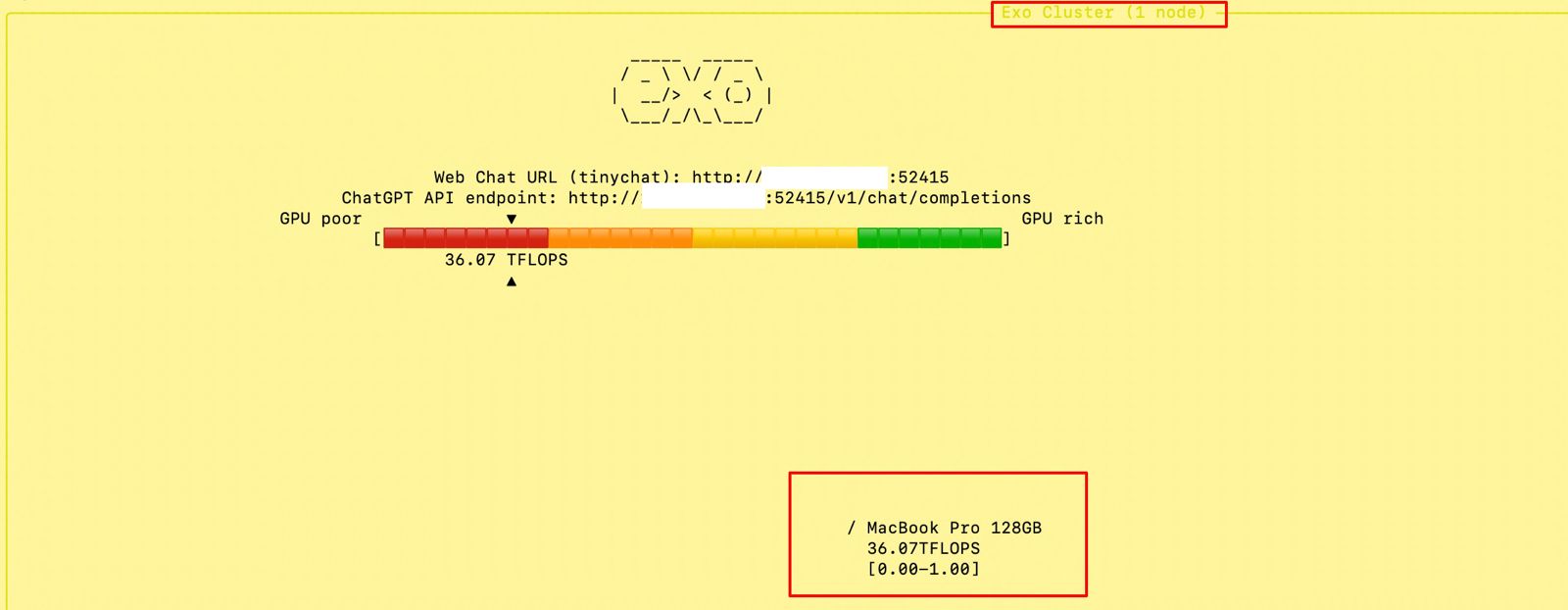
At the beginning, if we trigger the main MacBook Pro Max, the “Exo” screen should looks like this –

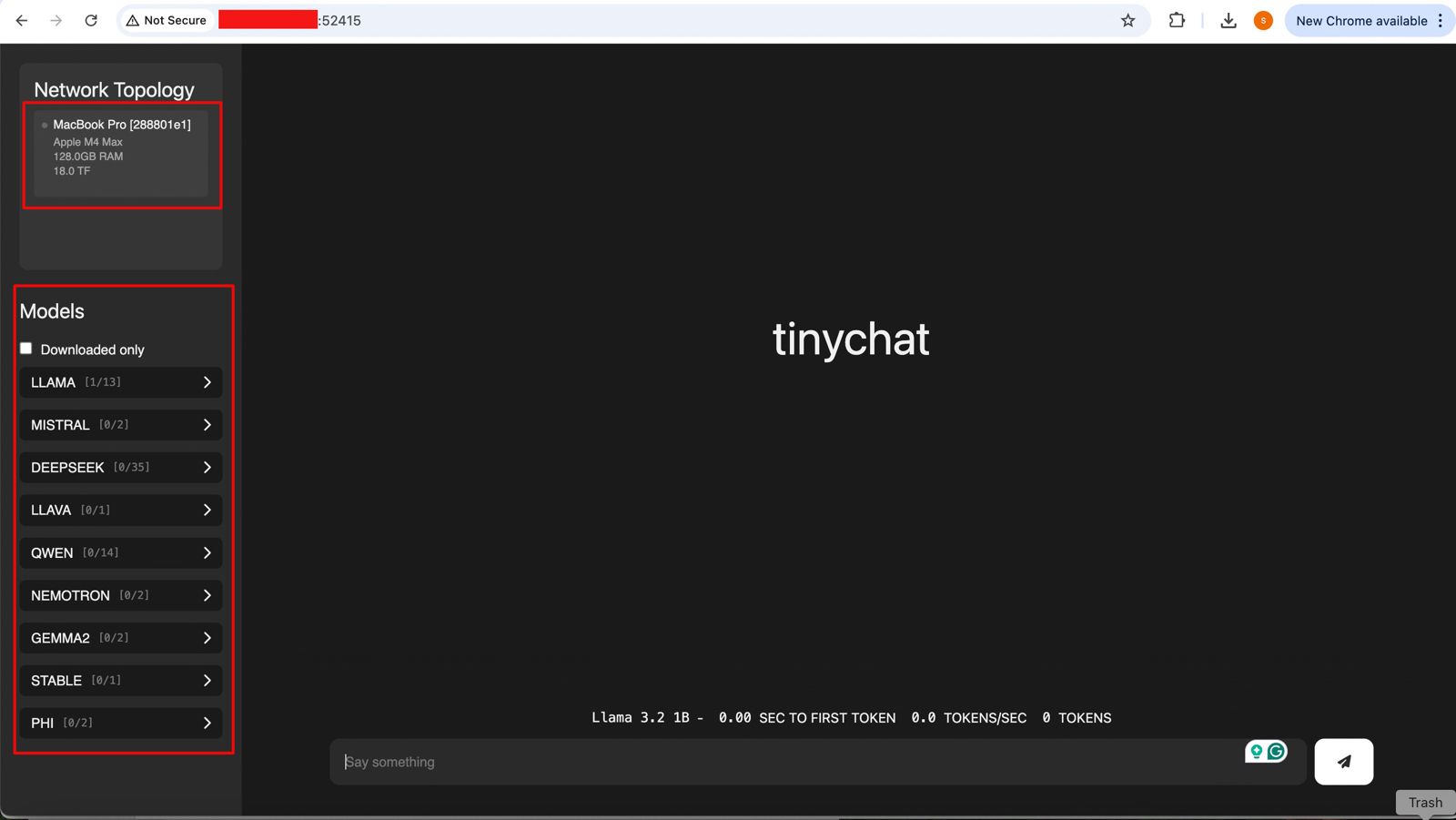
And if you open the URL, you will see the following ChatGPT-like interface –

Connecting without the Thunderbolt bridge with the relevant port or a hub may cause performance degradation. Hence, how you connect will play a major role in the success of this intention. However, this is certainly a great idea to proceed with.


So, we’ve done it.

We’ll cover the detailed performance testing, Optimized configurations & many other useful details in our next post.

Till then, Happy Avenging! 🙂

Monitoring & evaluating the leading LLMs (both the established & new) by Python-based evaluator

As we’re leaping more & more into the field of Generative AI, one of the frequent questions or challenges people are getting more & more is the performance & other evaluation factors. These factors will eventually bring the fruit of this technology; otherwise, you will end up in technical debt.

This post will discuss the key snippets of the monitoring app based on the Python-based AI app. But before that, let us first view the demo.

Isn’t it exciting?


Let us deep dive into it. But, here is the flow this solution will follow.

So, the current application will invoke the industry bigshots and some relatively unknown or new LLMs.

In this case, we’ll evaluate Anthropic, Open AI, DeepSeek, and Bharat GPT’s various models. However, Bharat GPT is open source, so we’ll use the Huggingface library and execute it locally against my MacBook Pro M4 Max.

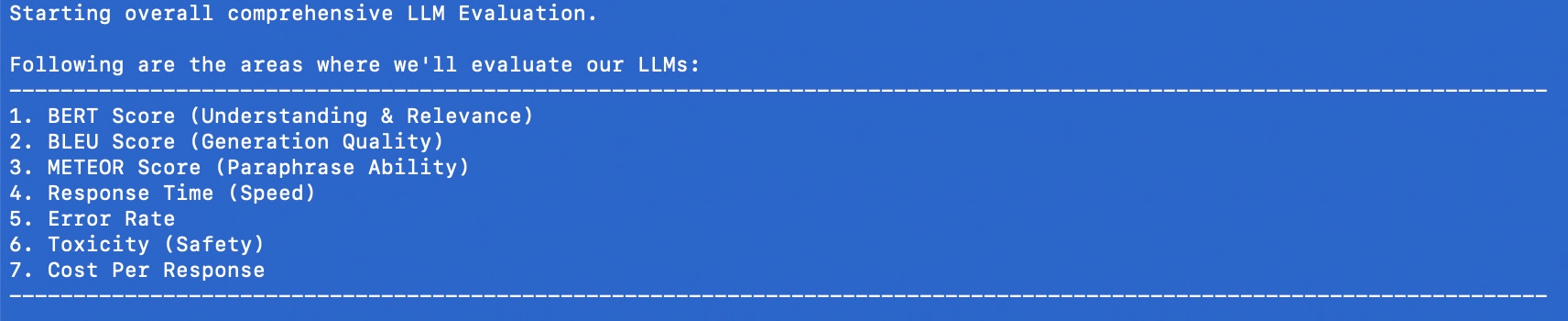
The following are the KPIs we’re going to evaluate:

Here are the lists of dependant python packages that is require to run this application –

pip install certifi==2024.8.30
pip install anthropic==0.42.0
pip install huggingface-hub==0.27.0
pip install nltk==3.9.1
pip install numpy==2.2.1
pip install moviepy==2.1.1
pip install numpy==2.1.3
pip install openai==1.59.3
pip install pandas==2.2.3
pip install pillow==11.1.0
pip install pip==24.3.1
pip install psutil==6.1.1
pip install requests==2.32.3
pip install rouge_score==0.1.2
pip install scikit-learn==1.6.0
pip install setuptools==70.2.0
pip install tokenizers==0.21.0
pip install torch==2.6.0.dev20250104
pip install torchaudio==2.6.0.dev20250104
pip install torchvision==0.22.0.dev20250104
pip install tqdm==4.67.1
pip install transformers==4.47.1
    @retry(stop=stop_after_attempt(3), wait=wait_exponential(multiplier=1, min=4, max=10))
    def get_claude_response(self, prompt: str) -> str:
        response = self.anthropic_client.messages.create(
            model=anthropic_model,
            max_tokens=maxToken,
            messages=[{"role": "user", "content": prompt}]
        )
        return response.content[0].text
  1. The Retry Mechanism
    • The @retry line means this function will automatically try again if it fails.
    • It will stop retrying after 3 attempts (stop_after_attempt(3)).
    • It will wait longer between retries, starting at 4 seconds and increasing up to 10 seconds (wait_exponential(multiplier=1, min=4, max=10)).
  2. The Function Purpose
    • The function takes a message, called prompt, as input (a string of text).
    • It uses a service (likely an AI system like Claude) to generate a response to this prompt.
  3. Sending the Message
    • Inside the function, the code self.anthropic_client.messages.create is the part that actually sends the prompt to the AI.
    • It specifies:Which AI model to use (e.g., anthropic_model).
    • The maximum length of the response (controlled by maxToken).
    • The input message for the AI has a “role” (user), as well as the content of the prompt.
  4. Getting the Response
    • Once the AI generates a response, it’s saved as response.
    • The code retrieves the first part of the response (response.content[0].text) and sends it back to whoever called the function.

Similarly, it will work for Open AI as well.

    @retry(stop=stop_after_attempt(3), wait=wait_exponential(multiplier=1, min=4, max=10))
    def get_deepseek_response(self, prompt: str) -> tuple:
        deepseek_api_key = self.deepseek_api_key

        headers = {
            "Authorization": f"Bearer {deepseek_api_key}",
            "Content-Type": "application/json"
            }
        
        payload = {
            "model": deepseek_model,  
            "messages": [{"role": "user", "content": prompt}],
            "max_tokens": maxToken
            }
        
        response = requests.post(DEEPSEEK_API_URL, headers=headers, json=payload)

        if response.status_code == 200:
            res = response.json()["choices"][0]["message"]["content"]
        else:
            res = "API request failed with status code " + str(response.status_code) + ":" + str(response.text)

        return res
  1. Retry Mechanism:
    • The @retry line ensures the function will try again if it fails.
    • It will stop retrying after 3 attempts (stop_after_attempt(3)).
    • It waits between retries, starting at 4 seconds and increasing up to 10 seconds (wait_exponential(multiplier=1, min=4, max=10)).

  1. What the Function Does:
    • The function takes one input, prompt, which is the message or question you want to send to the AI.
    • It returns the AI’s response or an error message.

  1. Preparing to Communicate with the API:
    • API Key: It gets the API key for the DeepSeek service from self.deepseek_api_key.
    • Headers: These tell the API that the request will use the API key (for security) and that the data format is JSON (structured text).
    • Payload: This is the information sent to the AI. It includes:
      • Model: Specifies which version of the AI to use (deepseek_model).
      • Messages: The input message with the role “user” and your prompt.
      • Max Tokens: Defines the maximum size of the AI’s response (maxToken).

  1. Sending the Request:
    • It uses the requests.post() method to send the payload and headers to the DeepSeek API using the URL DEEPSEEK_API_URL.

  1. Processing the Response:
    • If the API responds successfully (status_code == 200):
      • It extracts the AI’s reply from the response data.
      • Specifically, it gets the first choice’s message content: response.json()["choices"][0]["message"]["content"].
    • If there’s an error:
      • It constructs an error message with the status code and detailed error text from the API.

  1. Returning the Result:
    • The function outputs either the AI’s response or the error message.
    @retry(stop=stop_after_attempt(3), wait=wait_exponential(multiplier=1, min=4, max=10))
    def get_bharatgpt_response(self, prompt: str) -> tuple:
        try:
            messages = [[{"role": "user", "content": prompt}]]
            
            response = pipe(messages, max_new_tokens=maxToken,)

            # Extract 'content' field safely
            res = next((entry.get("content", "")
                        for entry in response[0][0].get("generated_text", [])
                        if isinstance(entry, dict) and entry.get("role") == "assistant"
                        ),
                        None,
                        )
            
            return res
        except Exception as e:
            x = str(e)
            print('Error: ', x)

            return ""
  1. Retry Mechanism:The @retry ensures the function will try again if it fails.
    • It will stop retrying after 3 attempts (stop_after_attempt(3)).
    • The waiting time between retries starts at 4 seconds and increases exponentially up to 10 seconds (wait_exponential(multiplier=1, min=4, max=10)).
  2. What the Function Does:The function takes one input, prompt, which is the message or question you want to send to BharatGPT.
    • It returns the AI’s response or an empty string if something goes wrong.
  3. Sending the Prompt:Messages Structure: The function wraps the user’s prompt in a format that the BharatGPT AI understands:
    • messages = [[{"role": "user", "content": prompt}]]
    • This tells the AI that the prompt is coming from the “user.”
  4. Pipe Function: It uses a pipe() method to send the messages to the AI system.
    • max_new_tokens=maxToken: Limits how long the AI’s response can be.
  5. Extracting the Response:The response from the AI is in a structured format. The code looks for the first piece of text where:
    • The role is “assistant” (meaning it’s the AI’s reply).
    • The text is in the “content” field.
    • The next() function safely extracts this “content” field or returns None if it can’t find it.
  6. Error Handling:If something goes wrong (e.g., the AI doesn’t respond or there’s a technical issue), the code:
    • Captures the error message in e.
    • Prints the error message: print('Error: ', x).
    • Returns an empty string ("") instead of crashing.
  7. Returning the Result:If everything works, the function gives you the AI’s response as plain text.
    • If there’s an error, it gives you an empty string, indicating no response was received.

    def get_model_response(self, model_name: str, prompt: str) -> ModelResponse:
        """Get response from specified model with metrics"""
        start_time = time.time()
        start_memory = psutil.Process(os.getpid()).memory_info().rss / 1024 / 1024

        try:
            if model_name == "claude-3":
                response_content = self.get_claude_response(prompt)
            elif model_name == "gpt4":
                response_content = self.get_gpt4_response(prompt)
            elif model_name == "deepseek-chat":
                response_content = self.get_deepseek_response(prompt)
            elif model_name == "bharat-gpt":
                response_content = self.get_bharatgpt_response(prompt)

            # Model-specific API calls 
            token_count = len(self.bert_tokenizer.encode(response_content))
            
            end_memory = psutil.Process(os.getpid()).memory_info().rss / 1024 / 1024
            memory_usage = end_memory - start_memory
            
            return ModelResponse(
                content=response_content,
                response_time=time.time() - start_time,
                token_count=token_count,
                memory_usage=memory_usage
            )
        except Exception as e:
            logging.error(f"Error getting response from {model_name}: {str(e)}")
            return ModelResponse(
                content="",
                response_time=0,
                token_count=0,
                memory_usage=0,
                error=str(e)
            )

Start Tracking Time and Memory:

    • The function starts a timer (start_time) to measure how long it takes to get a response.
    • It also checks how much memory is being used at the beginning (start_memory).

    Choose the AI Model:

    • Based on the model_name provided, the function selects the appropriate method to get a response:
      • "claude-3" → Calls get_claude_response(prompt).
      • "gpt4" → Calls get_gpt4_response(prompt).
      • "deepseek-chat" → Calls get_deepseek_response(prompt).
      • "bharat-gpt" → Calls get_bharatgpt_response(prompt).

    Process the Response:

    • Once the response is received, the function calculates:
      • Token Count: The number of tokens (small chunks of text) in the response using a tokenizer.
      • Memory Usage: The difference between memory usage after the response (end_memory) and before it (start_memory).

    Return the Results:

    • The function bundles all the information into a ModelResponse object:
      • The AI’s reply (content).
      • How long the response took (response_time).
      • The number of tokens in the reply (token_count).
      • How much memory was used (memory_usage).

    Handle Errors:

    • If something goes wrong (e.g., the AI doesn’t respond), the function:
      • Logs the error message.
      • Returns an empty response with default values and the error message.
        def evaluate_text_quality(self, generated: str, reference: str) -> Dict[str, float]:
            """Evaluate text quality metrics"""
            # BERTScore
            gen_embedding = self.sentence_model.encode([generated])
            ref_embedding = self.sentence_model.encode([reference])
            bert_score = cosine_similarity(gen_embedding, ref_embedding)[0][0]
    
            # BLEU Score
            generated_tokens = word_tokenize(generated.lower())
            reference_tokens = word_tokenize(reference.lower())
            bleu = sentence_bleu([reference_tokens], generated_tokens)
    
            # METEOR Score
            meteor = meteor_score([reference_tokens], generated_tokens)
    
            return {
                'bert_score': bert_score,
                'bleu_score': bleu,
                'meteor_score': meteor
            }

    Inputs:

    • generated: The text produced by the AI.
    • reference: The correct or expected version of the text.

    Calculating BERTScore:

    • Converts the generated and reference texts into numerical embeddings (mathematical representations) using a pre-trained model (self.sentence_model.encode).
    • Measures the similarity between the two embeddings using cosine similarity. This gives the bert_score, which ranges from -1 (completely different) to 1 (very similar).

    Calculating BLEU Score:

    • Breaks the generated and reference texts into individual words (tokens) using word_tokenize.
    • Converts both texts to lowercase for consistent comparison.
    • Calculates the BLEU Score (sentence_bleu), which checks how many words or phrases in the generated text overlap with the reference. BLEU values range from 0 (no match) to 1 (perfect match).

    Calculating METEOR Score:

    • Also uses the tokenized versions of generated and reference texts.
    • Calculates the METEOR Score (meteor_score), which considers exact matches, synonyms, and word order. Scores range from 0 (no match) to 1 (perfect match).

    Returning the Results:

    • Combines the three scores into a dictionary with the keys 'bert_score''bleu_score', and 'meteor_score'.

    Similarly, other functions are developed.

        def run_comprehensive_evaluation(self, evaluation_data: List[Dict]) -> pd.DataFrame:
            """Run comprehensive evaluation on all metrics"""
            results = []
            
            for item in evaluation_data:
                prompt = item['prompt']
                reference = item['reference']
                task_criteria = item.get('task_criteria', {})
                
                for model_name in self.model_configs.keys():
                    # Get multiple responses to evaluate reliability
                    responses = [
                        self.get_model_response(model_name, prompt)
                        for _ in range(3)  # Get 3 responses for reliability testing
                    ]
                    
                    # Use the best response for other evaluations
                    best_response = max(responses, key=lambda x: len(x.content) if not x.error else 0)
                    
                    if best_response.error:
                        logging.error(f"Error in model {model_name}: {best_response.error}")
                        continue
                    
                    # Gather all metrics
                    metrics = {
                        'model': model_name,
                        'prompt': prompt,
                        'response': best_response.content,
                        **self.evaluate_text_quality(best_response.content, reference),
                        **self.evaluate_factual_accuracy(best_response.content, reference),
                        **self.evaluate_task_performance(best_response.content, task_criteria),
                        **self.evaluate_technical_performance(best_response),
                        **self.evaluate_reliability(responses),
                        **self.evaluate_safety(best_response.content)
                    }
                    
                    # Add business impact metrics using task performance
                    metrics.update(self.evaluate_business_impact(
                        best_response,
                        metrics['task_completion']
                    ))
                    
                    results.append(metrics)
            
            return pd.DataFrame(results)
    • Input:
      • evaluation_data: A list of test cases, where each case is a dictionary containing:
        • prompt: The question or input to the AI model.
        • reference: The ideal or expected answer.
        • task_criteria (optional): Additional rules or requirements for the task.
    • Initialize Results:
      • An empty list results is created to store the evaluation metrics for each model and test case.
    • Iterate Through Test Cases:
      • For each item in the evaluation_data:
        • Extract the promptreference, and task_criteria.
    • Evaluate Each Model:
      • Loop through all available AI models (self.model_configs.keys()).
      • Generate three responses for each model to test reliability.
    • Select the Best Response:
      • Out of the three responses, pick the one with the most content (best_response), ignoring responses with errors.
    • Handle Errors:
      • If a response has an error, log the issue and skip further evaluation for that model.
    • Evaluate Metrics:
      • Using the best_response, calculate a variety of metrics, including:
        • Text Quality: How similar the response is to the reference.
        • Factual Accuracy: Whether the response is factually correct.
        • Task Performance: How well it meets task-specific criteria.
        • Technical Performance: Evaluate time, memory, or other system-related metrics.
        • Reliability: Check consistency across multiple responses.
        • Safety: Ensure the response is safe and appropriate.
    • Evaluate Business Impact:
      • Add metrics for business impact (e.g., how well the task was completed, using task_completion as a key factor).
    • Store Results:
      • Add the calculated metrics for this model and prompt to the results list.
    • Return Results as a DataFrame:
      • Convert the results list into a structured table (a pandas DataFrame) for easy analysis and visualization.

    Great! So, now, we’ve explained the code.

    Let us understand the final outcome of this run & what we can conclude from that.

    1. BERT Score (Semantic Understanding):
      • GPT4 leads slightly at 0.8322 (83.22%)
      • Bharat-GPT close second at 0.8118 (81.18%)
      • Claude-3 at 0.8019 (80.19%)
      • DeepSeek-Chat at 0.7819 (78.19%) Think of this like a “comprehension score” – how well the models understand the context. All models show strong understanding, with only a 5% difference between best and worst.
    2. BLEU Score (Word-for-Word Accuracy):
      • Bharat-GPT leads at 0.0567 (5.67%)
      • Claude-3 at 0.0344 (3.44%)
      • GPT4 at 0.0306 (3.06%)
      • DeepSeek-Chat lowest at 0.0189 (1.89%) These low scores suggest models use different wording than references, which isn’t necessarily bad.
    3. METEOR Score (Meaning Preservation):
      • Bharat-GPT leads at 0.4684 (46.84%)
      • Claude-3 close second at 0.4507 (45.07%)
      • GPT4 at 0.2960 (29.60%)
      • DeepSeek-Chat at 0.2652 (26.52%) This shows how well models maintain meaning while using different words.
    4. Response Time (Speed):
      • Claude-3 fastest: 4.40 seconds
      • Bharat-GPT: 6.35 seconds
      • GPT4: 6.43 seconds
      • DeepSeek-Chat slowest: 8.52 seconds
    5. Safety and Reliability:
      • Error Rate: Perfect 0.0 for all models
      • Toxicity: All very safe (below 0.15%) 
        • Claude-3 safest at 0.0007GPT4 at 0.0008Bharat-GPT at 0.0012
        • DeepSeek-Chat at 0.0014
    6. Cost Efficiency:
      • Claude-3 most economical: $0.0019 per response
      • Bharat-GPT close: $0.0021
      • GPT4: $0.0038
      • DeepSeek-Chat highest: $0.0050

    Key Takeaways by Model:

    1. Claude-3: ✓ Fastest responses ✓ Most cost-effective ✓ Excellent meaning preservation ✓ Lowest toxicity
    2. Bharat-GPT: ✓ Best BLEU and METEOR scores ✓ Strong semantic understanding ✓ Cost-effective ✗ Moderate response time
    3. GPT4: ✓ Best semantic understanding ✓ Good safety metrics ✗ Higher cost ✗ Moderate response time
    4. DeepSeek-Chat: ✗ Generally lower performance ✗ Slowest responses ✗ Highest cost ✗ Slightly higher toxicity

    Reliability of These Statistics:

    Strong Points:

    • Comprehensive metric coverage
    • Consistent patterns across evaluations
    • Zero error rates show reliability
    • Clear differentiation between models

    Limitations:

    • BLEU scores are quite low across all models
    • Doesn’t measure creative or innovative responses
    • May not reflect specific use case performance
    • Single snapshot rather than long-term performance

    Final Observation:

    1. Best Overall Value: Claude-3
      • Fast, cost-effective, safe, good performance
    2. Best for Accuracy: Bharat-GPT
      • Highest meaning preservation and precision
    3. Best for Understanding: GPT4
      • Strongest semantic comprehension
    4. Consider Your Priorities: 
      • Speed → Choose Claude-3
      • Cost → Choose Claude-3 or Bharat-GPT
      • Accuracy → Choose Bharat-GPT
      • Understanding → Choose GPT4

    These statistics provide reliable comparative data but should be part of a broader decision-making process that includes your specific needs, budget, and use cases.


    For the Bharat GPT model, we’ve tested this locally on my MacBook Pro 4 Max. And, the configuration is as follows –

    I’ve tried the API version locally, & it provided a similar performance against the stats that we received by running locally. Unfortunately, they haven’t made the API version public yet.

    So, apart from the Anthropic & Open AI, I’ll watch this new LLM (Bharat GPT) for overall stats in the coming days.


    So, we’ve done it.

    You can find the detailed code at the GitHub link.

    I’ll bring some more exciting topics in the coming days from the Python verse.

    Till then, Happy Avenging! 🙂

    Building solutions using LLM AutoGen in Python – Part 3

    Before we dive into the details of this post, let us provide the previous two links that precede it.

    Building solutions using LLM AutoGen in Python – Part 1

    Building solutions using LLM AutoGen in Python – Part 2

    For, reference, we’ll share the demo before deep dive into the actual follow-up analysis in the below section –


    In this post, we will understand the initial code generated & then the revised code to compare them for a better understanding of the impact of revised prompts.

    But, before that let us broadly understand the communication types between the agents.

    • Agents InvolvedAgent1Agent2
    • Flow:
      • Agent1 sends a request directly to Agent2.
      • Agent2 processes the request and sends the response back to Agent1.
    • Use Case: Simple query-response interactions without intermediaries.
    • Agents InvolvedUserAgentMediatorSpecialistAgent1SpecialistAgent2
    • Flow:
      • UserAgent sends input to Mediator.
      • Mediator delegates tasks to SpecialistAgent1 and SpecialistAgent2.
      • Specialists process tasks and return results to Mediator.
      • Mediator consolidates results and sends them back to UserAgent.
    • Agents InvolvedBroadcasterAgentAAgentBAgentC
    • Flow:
      • Broadcaster sends a message to multiple agents simultaneously.
      • Agents that find the message relevant (AgentAAgentC) acknowledge or respond.
    • Use Case: System-wide notifications or alerts.
    • Agents InvolvedSupervisorWorker1Worker2
    • Flow:
      • Supervisor assigns tasks to Worker1 and Worker2.
      • Workers execute tasks and report progress back to Supervisor.
    • Use Case: Task delegation in structured organizations.
    • Agents InvolvedPublisherSubscriber1Topic
    • Flow:
      • Publisher publishes an event or message to a Topic.
      • Subscriber1, who is subscribed to the Topic, receives the event.
    • Use Case: Decoupled systems where publishers and subscribers do not need direct knowledge of each other.
    • Agents InvolvedTriggerEventReactiveAgentNextStep
    • Flow:
      • An event occurs (TriggerEvent).
      • ReactiveAgent detects the event and acts.
      • The action leads to the NextStep in the process.
    • Use Case: Systems that need to respond to asynchronous events or changes in the environment.

    Since, we now understand the basic communication types. Let us understand the AutoGen generated first code & the last code (That satisfies our need) –

    # filename: simple_snake.py (Generated by AutoGen)
    
    import pygame
    import time
    import random
     
    snake_speed = 15
     
    # Window color
    white = pygame.Color(255, 255, 255)
     
    # Snake color
    green = pygame.Color(0, 255, 0)
     
    snake_position = [100, 50]
     
    # defining first 4 blocks 
    # of snake body
    snake_body = [ [100, 50], 
                   [90, 50],
                   [80, 50],
                   [70, 50]
                ]
    # fruit position
    fruit_position = [random.randrange(1, (1000//10)) * 10, 
                      random.randrange(1, (600//10)) * 10]
    fruit_spawn = True
     
    direction = 'RIGHT'
    change_to = direction
     
    score = 0
     
    # Initialising pygame
    pygame.init()
     
    # Initialise game window
    win = pygame.display.set_mode((1000, 600))
    pygame.display.set_caption("Snake game for kids")
     
    # FPS (frames per second) controller
    fps_controller = pygame.time.Clock()
     
      
    while True:
        # handling key events
        for event in pygame.event.get():
            if event.type == pygame.KEYDOWN:
                if event.key == pygame.K_UP:
                    change_to = 'UP'
                if event.key == pygame.K_DOWN:
                    change_to = 'DOWN'
                if event.key == pygame.K_LEFT:
                    change_to = 'LEFT'
                if event.key == pygame.K_RIGHT:
                    change_to = 'RIGHT'
    
        # If two keys pressed simultaneously
        # we don't want snake to move into two
        # directions simultaneously
        if change_to == 'UP' and direction != 'DOWN':
            direction = 'UP'
        if change_to == 'DOWN' and direction != 'UP':
            direction = 'DOWN'
        if change_to == 'LEFT' and direction != 'RIGHT':
            direction = 'LEFT'
        if change_to == 'RIGHT' and direction != 'LEFT':
            direction = 'RIGHT'
     
        # Moving the snake
        if direction == 'UP':
            snake_position[1] -= 10
        if direction == 'DOWN':
            snake_position[1] += 10
        if direction == 'LEFT':
            snake_position[0] -= 10
        if direction == 'RIGHT':
            snake_position[0] += 10
     
        # Snake body growing mechanism
        # if fruits and snakes collide then scores
        # will increase by 10
        snake_body.insert(0, list(snake_position))
        if snake_position[0] == fruit_position[0] and snake_position[1] == fruit_position[1]:
            score += 10
            fruit_spawn = False
        else:
            snake_body.pop()
             
        if not fruit_spawn:
            fruit_position = [random.randrange(1, (1000//10)) * 10, 
                              random.randrange(1, (600//10)) * 10]
             
        fruit_spawn = True
        win.fill(white)
        
        for pos in snake_body:
            pygame.draw.rect(win, green, pygame.Rect(pos[0], pos[1], 10, 10))
        pygame.draw.rect(win, white, pygame.Rect(
        fruit_position[0], fruit_position[1], 10, 10))
     
        # Game Over conditions
        if snake_position[0] < 0 or snake_position[0] > 1000-10:
            break
        if snake_position[1] < 0 or snake_position[1] > 600-10:
            break
     
        # Touching the snake body
        for block in snake_body[1:]:
            if snake_position[0] == block[0] and snake_position[1] == block[1]:
                break
        
        # refresh game screen
        pygame.display.update()
    
        # Frame Per Second /Refresh rate
        fps_controller.tick(snake_speed)
    
    # displaying final score after game over
    print(f"You scored {score} in the game.")

    Now, let us remember the prompt refinement that we’ve done (We’ve already posted that in our last post as well) –

    I want to place the snake within the boundary of the visual wall & it should bounce each wall & then hit the target. And, it should increase the size. And, every time when it hits the target it will increase the score by 10. And, the application will run for 2 minutes, which will be displayed on the screen. This will exit once 2 minute is over.
    # filename: simple_snake.py (Generated by AutoGen)
    
    import pygame
    import time
    import random
    import math
    
    pygame.init()
    
    white = (255, 255, 255)
    yellow = (255, 255, 102)
    green = (0, 255, 0)
    red = (255, 0, 0)
    black = (0, 0, 0)
    blue = (0, 0, 255)
    
    dis_width = 800
    dis_height = 600
    
    dis = pygame.display.set_mode((dis_width, dis_height))
    pygame.display.set_caption('Snake Game')
    
    clock = pygame.time.Clock()
    snake_block = 10
    snake_speed = 30
    font_style = pygame.font.SysFont(None, 50)
    score_font = pygame.font.SysFont(None, 35)
    
    def our_snake(snake_block, snake_List):
        for x in snake_List:
            pygame.draw.rect(dis, green, [x[0], x[1], snake_block, snake_block])
    
    def message(msg,color):
        mesg = font_style.render(msg, True, color)
        dis.blit(mesg, [dis_width / 3, dis_height / 3])
    
    def gameLoop():  # creating a function
        game_over = False
        game_close = False
    
        # snake starting coordinates
        x1 = dis_width / 2
        y1 = dis_height / 2
    
        # snake initial movement direction
        x1_change = 0
        y1_change = 0
    
        # initialize snake length and list of coordinates
        snake_List = []
        Length_of_snake = 1
    
        # random starting point for the food
        foodx = round(random.randrange(0, dis_width - snake_block) / 10.0) * 10.0
        foody = round(random.randrange(0, dis_height - snake_block) / 10.0) * 10.0
    
        # initialize score
        score = 0
    
        # store starting time
        start_time = time.time()
    
        while not game_over:
    
            # Remaining time
            elapsed_time = time.time() - start_time
            remaining_time = 120 - elapsed_time  # 2 minutes game
            if remaining_time <= 0:
                game_over = True
    
            # event handling loop
            for event in pygame.event.get():
                if event.type == pygame.QUIT:
                    game_over = True  # when closing window
                if event.type == pygame.MOUSEBUTTONUP:
                    # get mouse click coordinates
                    pos = pygame.mouse.get_pos()
    
                    # calculate new direction vector from snake to click position
                    x1_change = pos[0] - x1
                    y1_change = pos[1] - y1
    
                    # normalize direction vector
                    norm = math.sqrt(x1_change ** 2 + y1_change ** 2)
                    if norm != 0:
                        x1_change /= norm
                        y1_change /= norm
    
                    # multiply direction vector by step size
                    x1_change *= snake_block
                    y1_change *= snake_block
    
            x1 += x1_change
            y1 += y1_change
            dis.fill(white)
            pygame.draw.rect(dis, red, [foodx, foody, snake_block, snake_block])
            pygame.draw.rect(dis, green, [x1, y1, snake_block, snake_block])
            snake_Head = []
            snake_Head.append(x1)
            snake_Head.append(y1)
            snake_List.append(snake_Head)
            if len(snake_List) > Length_of_snake:
                del snake_List[0]
    
            our_snake(snake_block, snake_List)
    
            # Bounces the snake back if it hits the edge
            if x1 < 0 or x1 > dis_width:
                x1_change *= -1
            if y1 < 0 or y1 > dis_height:
                y1_change *= -1
    
            # Display score
            value = score_font.render("Your Score: " + str(score), True, black)
            dis.blit(value, [0, 0])
    
            # Display remaining time
            time_value = score_font.render("Remaining Time: " + str(int(remaining_time)), True, blue)
            dis.blit(time_value, [0, 30])
    
            pygame.display.update()
    
            # Increase score and length of snake when snake gets the food
            if abs(x1 - foodx) < snake_block and abs(y1 - foody) < snake_block:
                foodx = round(random.randrange(0, dis_width - snake_block) / 10.0) * 10.0
                foody = round(random.randrange(0, dis_height - snake_block) / 10.0) * 10.0
                Length_of_snake += 1
                score += 10
    
            # Snake movement speed
            clock.tick(snake_speed)
    
        pygame.quit()
        quit()
    
    gameLoop()
    

    Now, let us understand the difference here –

    The first program is a snake game controlled by arrow keys that end if the Snake hits a wall or itself. The second game uses mouse clicks for control, bounces off walls instead of ending, includes a 2-minute timer, and displays the remaining time.

    So, we’ve done it. 🙂

    You can find the detailed code in the following Github link.


    I’ll bring some more exciting topics in the coming days from the Python verse.

    Till then, Happy Avenging! 🙂

    Building the optimized Indic Language bot by using the Python-based Sarvam AI LLMs – Part 2

    As we discover in our previous post about the Sarvam AI basic capabilities & a glimpse of code review. Today, we’ll finish the rest of the part & some of the matrices comparing against other popular LLMs.

    Before that, you can refer to the previous post for a recap, which is available here.

    Also, we’re providing the demo here –


    Now, let us jump into the rest of the code –

    clsSarvamAI.py (This script will capture the audio input in Indic languages & then provide an LLM response in the form of audio in Indic languages. In this post, we’ll discuss part of the code. In the next part, we’ll be discussing the next important methods. Note that we’re only going to discuss a few important functions here.)

    def createWavFile(self, audio, output_filename="output.wav", target_sample_rate=16000):
          try:
              # Get the raw audio data as bytes
              audio_data = audio.get_raw_data()
    
              # Get the original sample rate
              original_sample_rate = audio.sample_rate
    
              # Open the output file in write mode
              with wave.open(output_filename, 'wb') as wf:
                  # Set parameters: nchannels, sampwidth, framerate, nframes, comptype, compname
                  wf.setnchannels(1)  # Assuming mono audio
                  wf.setsampwidth(2)  # 16-bit audio (int16)
                  wf.setframerate(original_sample_rate)
    
                  # Write audio data in chunks
                  chunk_size = 1024 * 10  # Chunk size (adjust based on memory constraints)
                  for i in range(0, len(audio_data), chunk_size):
                      wf.writeframes(audio_data[i:i+chunk_size])
    
              # Log the current timestamp
              var = datetime.datetime.now().strftime("%Y-%m-%d_%H-%M-%S")
              print('Audio Time: ', str(var))
    
              return 0
    
          except Exception as e:
              print('Error: <Wav File Creation>: ', str(e))
              return 1

    Purpose:

    This method saves recorded audio data into a WAV file format.

    What it Does:

    • Takes raw audio data and converts it into bytes.
    • Gets the original sample rate of the audio.
    • Opens a new WAV file in write mode.
    • Sets the parameters for the audio file (like the number of channels, sample width, and frame rate).
    • Writes the audio data into the file in small chunks to manage memory usage.
    • Logs the current time to keep track of when the audio was saved.
    • Returns 0 on success or 1 if there was an error.

    The “createWavFile” method takes the recorded audio and saves it as a WAV file on your computer. It converts the audio into bytes and writes them into small file parts. If something goes wrong, it prints an error message.


    def chunkBengaliResponse(self, text, max_length=500):
          try:
              chunks = []
              current_chunk = ""
    
              # Use regex to split on sentence-ending punctuation
              sentences = re.split(r'(।|\?|!)', text)
    
              for i in range(0, len(sentences), 2):
                  sentence = sentences[i] + (sentences[i+1] if i+1 < len(sentences) else '')
    
                  if len(current_chunk) + len(sentence) <= max_length:
                      current_chunk += sentence
                  else:
                      if current_chunk:
                          chunks.append(current_chunk.strip())
                      current_chunk = sentence
    
              if current_chunk:
                  chunks.append(current_chunk.strip())
    
              return chunks
          except Exception as e:
              x = str(e)
              print('Error: <<Chunking Bengali Response>>: ', x)
    
              return ''

    Purpose:

    This method breaks down a large piece of text (in Bengali) into smaller, manageable chunks.

    What it Does:

    • Initializes an empty list to store the chunks of text.
    • It uses a regular expression to split the text based on punctuation marks like full stops (।), question marks (?), and exclamation points (!).
    • Iterates through the split sentences to form chunks that do not exceed a specified maximum length (max_length).
    • Adds each chunk to the list until the entire text is processed.
    • Returns the list of chunks or an empty string if an error occurs.

    The chunkBengaliResponse method takes a long Bengali text and splits it into smaller, easier-to-handle parts. It uses punctuation marks to determine where to split. If there’s a problem while splitting, it prints an error message.


    def playWav(self, audio_data):
          try:
              # Create a wav file object from the audio data
              WavFile = wave.open(io.BytesIO(audio_data), 'rb')
    
              # Extract audio parameters
              channels = WavFile.getnchannels()
              sample_width = WavFile.getsampwidth()
              framerate = WavFile.getframerate()
              n_frames = WavFile.getnframes()
    
              # Read the audio data
              audio = WavFile.readframes(n_frames)
              WavFile.close()
    
              # Convert audio data to numpy array
              dtype_map = {1: np.int8, 2: np.int16, 3: np.int32, 4: np.int32}
              audio_np = np.frombuffer(audio, dtype=dtype_map[sample_width])
    
              # Reshape audio if stereo
              if channels == 2:
                  audio_np = audio_np.reshape(-1, 2)
    
              # Play the audio
              sd.play(audio_np, framerate)
              sd.wait()
    
              return 0
          except Exception as e:
              x = str(e)
              print('Error: <<Playing the Wav>>: ', x)
    
              return 1

    Purpose:

    This method plays audio data stored in a WAV file format.

    What it Does:

    • Reads the audio data from a WAV file object.
    • Extracts parameters like the number of channels, sample width, and frame rate.
    • Converts the audio data into a format that the sound device can process.
    • If the audio is stereo (two channels), it reshapes the data for playback.
    • Plays the audio through the speakers.
    • Returns 0 on success or 1 if there was an error.

    The playWav method takes audio data from a WAV file and plays it through your computer’s speakers. It reads the data and converts it into a format your speakers can understand. If there’s an issue playing the audio, it prints an error message.


      def audioPlayerWorker(self, queue):
          try:
              while True:
                  var = datetime.datetime.now().strftime("%Y-%m-%d_%H-%M-%S")
                  print('Response Audio Time: ', str(var))
                  audio_bytes = queue.get()
                  if audio_bytes is None:
                      break
                  self.playWav(audio_bytes)
                  queue.task_done()
    
              return 0
          except Exception as e:
              x = str(e)
              print('Error: <<Audio Player Worker>>: ', x)
    
              return 1

    Purpose:

    This method continuously plays audio from a queue until there is no more audio to play.

    What it Does:

    • It enters an infinite loop to keep checking for audio data in the queue.
    • Retrieves audio data from the queue and plays it using the “playWav”-method.
    • Logs the current time each time an audio response is played.
    • It breaks the loop if it encounters a None value, indicating no more audio to play.
    • Returns 0 on success or 1 if there was an error.

    The audioPlayerWorker method keeps checking a queue for new audio to play. It plays each piece of audio as it comes in and stops when there’s no more audio. If there’s an error during playback, it prints an error message.


      async def processChunk(self, chText, url_3, headers):
          try:
              sarvamAPIKey = self.sarvamAPIKey
              model_1 = self.model_1
              langCode_1 = self.langCode_1
              speakerName = self.speakerName
    
              print()
              print('Chunk Response: ')
              vText = chText.replace('*','').replace(':',' , ')
              print(vText)
    
              payload_3 = {
                  "inputs": [vText],
                  "target_language_code": langCode_1,
                  "speaker": speakerName,
                  "pitch": 0.15,
                  "pace": 0.95,
                  "loudness": 2.1,
                  "speech_sample_rate": 16000,
                  "enable_preprocessing": True,
                  "model": model_1
              }
              response_3 = requests.request("POST", url_3, json=payload_3, headers=headers)
              audio_data = response_3.text
              data = json.loads(audio_data)
              byte_data = data['audios'][0]
              audio_bytes = base64.b64decode(byte_data)
    
              return audio_bytes
          except Exception as e:
              x = str(e)
              print('Error: <<Process Chunk>>: ', x)
              audio_bytes = base64.b64decode('')
    
              return audio_bytes

    Purpose:

    This asynchronous method processes a chunk of text to generate audio using an external API.

    What it Does:

    • Cleans up the text chunk by removing unwanted characters.
    • Prepares a payload with the cleaned text and other parameters required for text-to-speech conversion.
    • Sends a POST request to an external API to generate audio from the text.
    • Decodes the audio data received from the API (in base64 format) into raw audio bytes.
    • Returns the audio bytes or an empty byte string if there is an error.

    The processChunk method takes a text, sends it to an external service to be converted into speech, and returns the audio data. If something goes wrong, it prints an error message.


      async def processAudio(self, audio):
          try:
              model_2 = self.model_2
              model_3 = self.model_3
              url_1 = self.url_1
              url_2 = self.url_2
              url_3 = self.url_3
              sarvamAPIKey = self.sarvamAPIKey
              audioFile = self.audioFile
              WavFile = self.WavFile
              langCode_1 = self.langCode_1
              langCode_2 = self.langCode_2
              speakerGender = self.speakerGender
    
              headers = {
                  "api-subscription-key": sarvamAPIKey
              }
    
              audio_queue = Queue()
              data = {
                  "model": model_2,
                  "prompt": templateVal_1
              }
              files = {
                  "file": (audioFile, open(WavFile, "rb"), "audio/wav")
              }
    
              response_1 = requests.post(url_1, headers=headers, data=data, files=files)
              tempDert = json.loads(response_1.text)
              regionalT = tempDert['transcript']
              langCd = tempDert['language_code']
              statusCd = response_1.status_code
              payload_2 = {
                  "input": regionalT,
                  "source_language_code": langCode_2,
                  "target_language_code": langCode_1,
                  "speaker_gender": speakerGender,
                  "mode": "formal",
                  "model": model_3,
                  "enable_preprocessing": True
              }
    
              response_2 = requests.request("POST", url_2, json=payload_2, headers=headers)
              regionalT_2 = response_2.text
              data_ = json.loads(regionalT_2)
              regionalText = data_['translated_text']
              chunked_response = self.chunkBengaliResponse(regionalText)
    
              audio_thread = Thread(target=self.audioPlayerWorker, args=(audio_queue,))
              audio_thread.start()
    
              for chText in chunked_response:
                  audio_bytes = await self.processChunk(chText, url_3, headers)
                  audio_queue.put(audio_bytes)
    
              audio_queue.join()
              audio_queue.put(None)
              audio_thread.join()
    
              var = datetime.datetime.now().strftime("%Y-%m-%d_%H-%M-%S")
              print('Retrieval Time: ', str(var))
    
              return 0
    
          except Exception as e:
              x = str(e)
              print('Error: <<Processing Audio>>: ', x)
    
              return 1

    Purpose:

    This asynchronous method handles the complete audio processing workflow, including speech recognition, translation, and audio playback.

    What it Does:

    • Initializes various configurations and headers required for processing.
    • Sends the recorded audio to an API to get the transcript and detected language.
    • Translates the transcript into another language using another API.
    • Splits the translated text into smaller chunks using the chunkBengaliResponse method.
    • Starts an audio playback thread to play each processed audio chunk.
    • Sends each text chunk to the processChunk method to convert to speech and adds the audio data to the queue for playback.
    • Waits for all audio chunks to be processed and played before finishing.
    • Logs the current time when the process is complete.
    • Returns 0 on success or 1 if there was an error.

    The “processAudio”-method takes recorded audio, recognizes what was said, translates it into another language, splits the translated text into parts, converts each part into speech, and plays it back. It uses different services to do this; if there’s a problem at any step, it prints an error message.

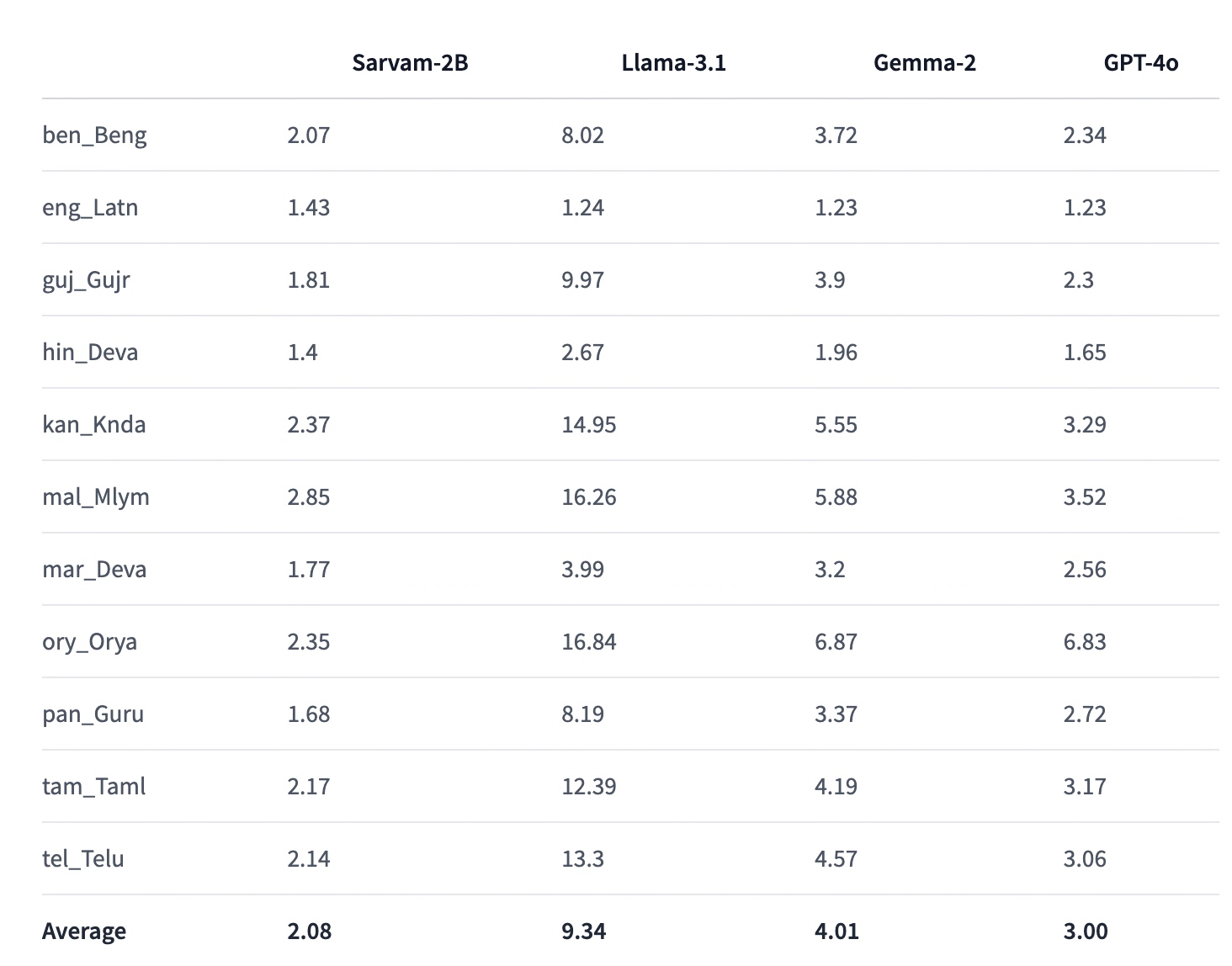
    And, here is the performance stats (Captured from Sarvam AI website) –


    So, finally, we’ve done it. You can view the complete code in this GitHub link.

    I’ll bring some more exciting topics in the coming days from the Python verse.

    Till then, Happy Avenging! 🙂

    Building the optimized Indic Language bot by using the Python-based Sarvam AI LLMs – Part 1

    In the rapidly evolving landscape of artificial intelligence, Sarvam AI has emerged as a pioneering force in developing language technologies for Indian languages. This article series aims to provide an in-depth look at Sarvam AI’s Indic APIs, exploring their features, performance, and potential impact on the Indian tech ecosystem.

    This LLM aims to bridge the language divide in India’s digital landscape by providing powerful, accessible AI tools for Indic languages.

    India has 22 official languages and hundreds of dialects, presenting a unique challenge for technology adoption and digital inclusion. Even though all the government work happens in both the official language along with English language.

    Developers can fine-tune the models for specific domains or use cases, improving accuracy for specialized applications.

    As of 2024, Sarvam AI’s Indic APIs support the following languages:

    • Hindi
    • Bengali
    • Tamil
    • Telugu
    • Marathi
    • Gujarati
    • Kannada
    • Malayalam
    • Punjabi
    • Odia

    Before delving into the details, I strongly recommend taking a look at the demo.

    Isn’t this exciting? Let us understand the flow of events in the following diagram –

    The application interacts with Sarvam AI’s API. After interpreting the initial audio inputs from the computer, it uses Sarvam AI’s API to get the answer based on the selected Indic language, Bengali.

    pip install SpeechRecognition==3.10.4
    pip install pydub==0.25.1
    pip install sounddevice==0.5.0
    pip install numpy==1.26.4
    pip install soundfile==0.12.1

    clsSarvamAI.py (This script will capture the audio input in Indic languages & then provide an LLM response in the form of audio in Indic languages. In this post, we’ll discuss part of the code. In the next part, we’ll be discussing the next important methods. Note that we’re only going to discuss a few important functions here.)

    def initializeMicrophone(self):
          try:
              for index, name in enumerate(sr.Microphone.list_microphone_names()):
                  print(f"Microphone with name \"{name}\" found (device_index={index})")
              return sr.Microphone()
          except Exception as e:
              x = str(e)
              print('Error: <<Initiating Microphone>>: ', x)
    
              return ''
    
      def realTimeTranslation(self):
          try:
              WavFile = self.WavFile
              recognizer = sr.Recognizer()
              try:
                  microphone = self.initializeMicrophone()
              except Exception as e:
                  print(f"Error initializing microphone: {e}")
                  return
    
              with microphone as source:
                  print("Adjusting for ambient noise. Please wait...")
                  recognizer.adjust_for_ambient_noise(source, duration=5)
                  print("Microphone initialized. Start speaking...")
    
                  try:
                      while True:
                          try:
                              print("Listening...")
                              audio = recognizer.listen(source, timeout=5, phrase_time_limit=5)
                              print("Audio captured. Recognizing...")
    
                              #var = datetime.datetime.now().strftime("%Y-%m-%d_%H-%M-%S")
                              #print('Before Audio Time: ', str(var))
    
                              self.createWavFile(audio, WavFile)
    
                              try:
                                  text = recognizer.recognize_google(audio, language="bn-BD")  # Bengali language code
                                  sentences = text.split('')  # Bengali full stop
    
                                  print('Sentences: ')
                                  print(sentences)
                                  print('*'*120)
    
                                  if not text:
                                      print("No speech detected. Please try again.")
                                      continue
    
                                  if str(text).lower() == 'টাটা':
                                      raise BreakOuterLoop("Based on User Choice!")
    
                                  asyncio.run(self.processAudio(audio))
    
                              except sr.UnknownValueError:
                                  print("Google Speech Recognition could not understand audio")
                              except sr.RequestError as e:
                                  print(f"Could not request results from Google Speech Recognition service; {e}")
    
                          except sr.WaitTimeoutError:
                              print("No speech detected within the timeout period. Listening again...")
                          except BreakOuterLoop:
                              raise
                          except Exception as e:
                              print(f"An unexpected error occurred: {e}")
    
                          time.sleep(1)  # Short pause before next iteration
    
                  except BreakOuterLoop as e:
                      print(f"Exited : {e}")
    
              # Removing the temporary audio file that was generated at the begining
              os.remove(WavFile)
    
              return 0
          except Exception as e:
              x = str(e)
              print('Error: <<Real-time Translation>>: ', x)
    
              return 1

    Purpose:

    This method is responsible for setting up and initializing the microphone for audio input.

    What it Does:

    • It attempts to list all available microphones connected to the system.
    • It prints the microphone’s name and corresponding device index (a unique identifier) for each microphone.
    • If successful, it returns a microphone object (sr.Microphone()), which can be used later to capture audio.
    • If this process encounters an error (e.g., no microphones being found or an internal error), it catches the exception, prints an error message, and returns an empty string (“).

    The “initializeMicrophone” Method finds all microphones connected to the computer and prints their names. If it finds a microphone, it prepares to use it for recording. If something goes wrong, it tells you what went wrong and stops the process.

    Purpose:
    This Method uses the microphone to handle real-time speech translation from a user. It captures spoken audio, converts it into text, and processes it further.

    What it Does:

    • Initializes a recognizer object (sr.Recognizer()) for speech recognition.
    • Call initializeMicrophone to set up the microphone. If initialization fails, an error message is printed, and the process is stopped.
    • Once the microphone is set up successfully, it adjusts for ambient noise to enhance accuracy.
    • Enters a loop to continuously listen for audio input from the user:
      • It waits for the user to speak and captures the audio.
      • Converts the captured audio to text using Google’s Speech Recognition service, specifying Bengali as the language.
      • If text is successfully captured and recognized:
        • Splits the text into sentences using the Bengali full-stop character.
        • Prints the sentences.
        • It checks if the text is a specific word (“টাটা”), and if so, it raises an exception to stop the loop (indicating that the user wants to exit).
        • Otherwise, it processes the audio asynchronously with processAudio.
      • If no speech is detected or an error occurs, it prints the relevant message and continues listening.
    • If the user decides to exit or if an error occurs, it breaks out of the loop, deletes any temporary audio files created, and returns a status code (0 for success, 1 for failure).


    The “realTimeTranslation” method continuously listens to the microphone for the user to speak. It captures what is said and tries to understand it using Google’s service, specifically for the Bengali language. It then splits what was said into sentences and prints them out. If the user says “টাটা” (which means “goodbye” in Bengali), it stops listening and exits. If it cannot understand the user or if there is a problem, it will let the user know and try again. It will print an error and stop the process if something goes wrong.


    Let’s wait for the next part & enjoy this part.

    Building & deploying a RAG architecture rapidly using Langflow & Python

    I’ve been looking for a solution that can help deploy any RAG solution involving Python faster. It would be more effective if an available UI helped deliver the solution faster. And, here comes the solution that does exactly what I needed – “LangFlow.”

    Before delving into the details, I strongly recommend taking a look at the demo. It’s a great way to get a comprehensive understanding of LangFlow and its capabilities in deploying RAG architecture rapidly.

    Demo

    This describes the entire architecture; hence, I’ll share the architecture components I used to build the solution.

    To know more about RAG-Architecture, please refer to the following link.

    As we all know, we can parse the data from the source website URL (in this case, I’m referring to my photography website to extract the text of one of my blogs) and then embed it into the newly created Astra DB & new collection, where I will be storing the vector embeddings.

    As you can see from the above diagram, the flow that I configured within 5 minutes and the full functionality of writing a complete solution (underlying Python application) within no time that extracts chunks, converts them into embeddings, and finally stores them inside the Astra DB.

    Now, let us understand the next phase, where, based on the ask from a chatbot, I need to convert that question into Vector DB & then find the similarity search to bring the relevant vectors as shown below –

    You need to configure this entire flow by dragging the necessary widgets from the left-side panel as marked in the Blue-Box shown below –

    For this specific use case, we’ve created an instance of Astra DB & then created an empty vector collection. Also, we need to ensure that we generate the API-Key & and provide the right roles assigned with the token. After successfully creating the token, you need to copy the endpoint, token & collection details & paste them into the desired fields of the Astra-DB components inside the LangFlow. Think of it as a framework where one needs to provide all the necessary information to build & run the entire flow successfully.

    Following are some of the important snapshots from the Astra-DB –

    Step – 1

    Step – 2

    Once you run the vector DB population, this will insert extracted text & then convert it into vectors, which will show in the following screenshot –

    You can see the sample vectors along with the text chunks inside the Astra DB data explorer as shown below –

    Some of the critical components are highlighted in the Blue-box which is important for us to monitor the vector embeddings.

    Now, here is how you can modify the current Python code of any available widgets or build your own widget by using the custom widget.

    The first step is to click the code button highlighted in the Red-box as shown below –

    The next step is when you click that button, which will open the detailed Python code representing the entire widget build & its functionality. This button is the place where you can add, modify, or keep it as it is depending upon your need, which will shown below –

    Once one builds the entire solution, you must click the final compile button (shown in the red box), which will eventually compile all the individual widgets. However, you can build the compile button for the individual widgets as soon as you make the solution. So you can pinpoint any potential problems at that very step.

    Let us understand one sample code of a widget. In this case, we will take vector embedding insertion into the Astra DB. Let us see the code –

    from typing import List, Optional, Union
    from langchain_astradb import AstraDBVectorStore
    from langchain_astradb.utils.astradb import SetupMode
    
    from langflow.custom import CustomComponent
    from langflow.field_typing import Embeddings, VectorStore
    from langflow.schema import Record
    from langchain_core.retrievers import BaseRetriever
    
    
    class AstraDBVectorStoreComponent(CustomComponent):
        display_name = "Astra DB"
        description = "Builds or loads an Astra DB Vector Store."
        icon = "AstraDB"
        field_order = ["token", "api_endpoint", "collection_name", "inputs", "embedding"]
    
        def build_config(self):
            return {
                "inputs": {
                    "display_name": "Inputs",
                    "info": "Optional list of records to be processed and stored in the vector store.",
                },
                "embedding": {"display_name": "Embedding", "info": "Embedding to use"},
                "collection_name": {
                    "display_name": "Collection Name",
                    "info": "The name of the collection within Astra DB where the vectors will be stored.",
                },
                "token": {
                    "display_name": "Token",
                    "info": "Authentication token for accessing Astra DB.",
                    "password": True,
                },
                "api_endpoint": {
                    "display_name": "API Endpoint",
                    "info": "API endpoint URL for the Astra DB service.",
                },
                "namespace": {
                    "display_name": "Namespace",
                    "info": "Optional namespace within Astra DB to use for the collection.",
                    "advanced": True,
                },
                "metric": {
                    "display_name": "Metric",
                    "info": "Optional distance metric for vector comparisons in the vector store.",
                    "advanced": True,
                },
                "batch_size": {
                    "display_name": "Batch Size",
                    "info": "Optional number of records to process in a single batch.",
                    "advanced": True,
                },
                "bulk_insert_batch_concurrency": {
                    "display_name": "Bulk Insert Batch Concurrency",
                    "info": "Optional concurrency level for bulk insert operations.",
                    "advanced": True,
                },
                "bulk_insert_overwrite_concurrency": {
                    "display_name": "Bulk Insert Overwrite Concurrency",
                    "info": "Optional concurrency level for bulk insert operations that overwrite existing records.",
                    "advanced": True,
                },
                "bulk_delete_concurrency": {
                    "display_name": "Bulk Delete Concurrency",
                    "info": "Optional concurrency level for bulk delete operations.",
                    "advanced": True,
                },
                "setup_mode": {
                    "display_name": "Setup Mode",
                    "info": "Configuration mode for setting up the vector store, with options likeSync,Async, orOff”.",
                    "options": ["Sync", "Async", "Off"],
                    "advanced": True,
                },
                "pre_delete_collection": {
                    "display_name": "Pre Delete Collection",
                    "info": "Boolean flag to determine whether to delete the collection before creating a new one.",
                    "advanced": True,
                },
                "metadata_indexing_include": {
                    "display_name": "Metadata Indexing Include",
                    "info": "Optional list of metadata fields to include in the indexing.",
                    "advanced": True,
                },
                "metadata_indexing_exclude": {
                    "display_name": "Metadata Indexing Exclude",
                    "info": "Optional list of metadata fields to exclude from the indexing.",
                    "advanced": True,
                },
                "collection_indexing_policy": {
                    "display_name": "Collection Indexing Policy",
                    "info": "Optional dictionary defining the indexing policy for the collection.",
                    "advanced": True,
                },
            }
    
        def build(
            self,
            embedding: Embeddings,
            token: str,
            api_endpoint: str,
            collection_name: str,
            inputs: Optional[List[Record]] = None,
            namespace: Optional[str] = None,
            metric: Optional[str] = None,
            batch_size: Optional[int] = None,
            bulk_insert_batch_concurrency: Optional[int] = None,
            bulk_insert_overwrite_concurrency: Optional[int] = None,
            bulk_delete_concurrency: Optional[int] = None,
            setup_mode: str = "Sync",
            pre_delete_collection: bool = False,
            metadata_indexing_include: Optional[List[str]] = None,
            metadata_indexing_exclude: Optional[List[str]] = None,
            collection_indexing_policy: Optional[dict] = None,
        ) -> Union[VectorStore, BaseRetriever]:
            try:
                setup_mode_value = SetupMode[setup_mode.upper()]
            except KeyError:
                raise ValueError(f"Invalid setup mode: {setup_mode}")
            if inputs:
                documents = [_input.to_lc_document() for _input in inputs]
    
                vector_store = AstraDBVectorStore.from_documents(
                    documents=documents,
                    embedding=embedding,
                    collection_name=collection_name,
                    token=token,
                    api_endpoint=api_endpoint,
                    namespace=namespace,
                    metric=metric,
                    batch_size=batch_size,
                    bulk_insert_batch_concurrency=bulk_insert_batch_concurrency,
                    bulk_insert_overwrite_concurrency=bulk_insert_overwrite_concurrency,
                    bulk_delete_concurrency=bulk_delete_concurrency,
                    setup_mode=setup_mode_value,
                    pre_delete_collection=pre_delete_collection,
                    metadata_indexing_include=metadata_indexing_include,
                    metadata_indexing_exclude=metadata_indexing_exclude,
                    collection_indexing_policy=collection_indexing_policy,
                )
            else:
                vector_store = AstraDBVectorStore(
                    embedding=embedding,
                    collection_name=collection_name,
                    token=token,
                    api_endpoint=api_endpoint,
                    namespace=namespace,
                    metric=metric,
                    batch_size=batch_size,
                    bulk_insert_batch_concurrency=bulk_insert_batch_concurrency,
                    bulk_insert_overwrite_concurrency=bulk_insert_overwrite_concurrency,
                    bulk_delete_concurrency=bulk_delete_concurrency,
                    setup_mode=setup_mode_value,
                    pre_delete_collection=pre_delete_collection,
                    metadata_indexing_include=metadata_indexing_include,
                    metadata_indexing_exclude=metadata_indexing_exclude,
                    collection_indexing_policy=collection_indexing_policy,
                )
    
            return vector_store
    

    Method: build_config:

    • This method defines the configuration options for the component.
    • Each configuration option includes a display_name and info, which provides details about the option.
    • Some options are marked as advanced, indicating they are optional and more complex.

    Method: build:

    • This method is used to create an instance of the Astra DB Vector Store.
    • It takes several parameters, including embedding, token, api_endpoint, collection_name, and various optional parameters.
    • It converts the setup_mode string to an enum value.
    • If inputs are provided, they are converted to a format suitable for storing in the vector store.
    • Depending on whether inputs are provided, a new vector store from documents can be created, or an empty vector store can be initialized with the given configurations.
    • Finally, it returns the created vector store instance.

    And, here is the the screenshot of your run –

    And, this is the last steps to run the Integrated Chatbot as shown below –

    As one can see the left side highlighted shows the reference text & chunks & the right side actual response.


    So, we’ve done it. And, you know the fun fact. I did this entire workflow within 35 minutes alone. 😛

    I’ll bring some more exciting topics in the coming days from the Python verse.

    To learn more about LangFlow, please click here.

    To learn about Astra DB, you need to click the following link.

    To learn about my blog & photography, you can click the following url.

    Till then, Happy Avenging!  🙂

    Building a real-time Gen AI Improvement Matrices (GAIIM) using Python, UpTrain, Open AI & React

    How does the RAG work better for various enterprise-level Gen AI use cases? What needs to be there to make the LLM model work more efficiently & able to check the response & validate their response, including the bias, hallucination & many more?

    This is my post (after a slight GAP), which will capture and discuss some of the burning issues that many AI architects are trying to explore. In this post, I’ve considered a newly formed AI start-up from India, which developed an open-source framework that can easily evaluate all the challenges that one is facing with their LLMs & easily integrate with your existing models for better understanding including its limitations. You will get plenty of insights about it.

    But, before we dig deep, why not see the demo first –

    Isn’t it exciting? Let’s deep dive into the flow of events.


    Let’s explore the broad-level architecture/flow –

    Let us understand the steps of the above architecture. First, our Python application needs to trigger and enable the API, which will interact with the Open AI and UpTrain AI to fetch all the LLM KPIs based on the input from the React app named “Evaluation.”

    Once the response is received from UpTrain AI, the Python application then organizes the results in a better readable manner without changing the core details coming out from their APIs & then shares that back with the react interface.

    Let’s examine the react app’s sample inputs to better understand the input that will be passed to the Python-based API solution, which is wrapper capability to call multiple APIs from the UpTrain & then accumulate them under one response by parsing the data & reorganizing the data with the help of Open AI & sharing that back.

    Highlighted in RED are some of the critical inputs you need to provide to get most of the KPIs. And, here are the sample text inputs for your reference –

    Q. Enter input question.
    A. What are the four largest moons of Jupiter?
    Q. Enter the context document.
    A. Jupiter, the largest planet in our solar system, boasts a fascinating array of moons. Among these, the four largest are collectively known as the Galilean moons, named after the renowned astronomer Galileo Galilei, who first observed them in 1610. These four moons, Io, Europa, Ganymede, and Callisto, hold significant scientific interest due to their unique characteristics and diverse geological features.
    Q. Enter LLM response.
    A. The four largest moons of Jupiter, known as the Galilean moons, are Io, Europa, Ganymede, and Marshmello.
    Q. Enter the persona response.
    A. strict and methodical teacher
    Q. Enter the guideline.
    A. Response shouldn’t contain any specific numbers
    Q. Enter the ground truth.
    A. The Jupiter is the largest & gaseous planet in the solar system.
    Q. Choose the evaluation method.
    A. llm

    Once you fill in the App should look like this –

    Once you fill in, the app should look like the below screenshot –


    Let us understand the sample packages that are required for this task.

    pip install Flask==3.0.3
    pip install Flask-Cors==4.0.0
    pip install numpy==1.26.4
    pip install openai==1.17.0
    pip install pandas==2.2.2
    pip install uptrain==0.6.13

    Note that, we’re not going to discuss the entire script here. Only those parts are relevant. However, you can get the complete scripts in the GitHub repository.

    def askFeluda(context, question):
        try:
            # Combine the context and the question into a single prompt.
            prompt_text = f"{context}\n\n Question: {question}\n Answer:"
    
            # Retrieve conversation history from the session or database
            conversation_history = []
    
            # Add the new message to the conversation history
            conversation_history.append(prompt_text)
    
            # Call OpenAI API with the updated conversation
            response = client.with_options(max_retries=0).chat.completions.create(
                messages=[
                    {
                        "role": "user",
                        "content": prompt_text,
                    }
                ],
                model=cf.conf['MODEL_NAME'],
                max_tokens=150,  # You can adjust this based on how long you expect the response to be
                temperature=0.3,  # Adjust for creativity. Lower values make responses more focused and deterministic
                top_p=1,
                frequency_penalty=0,
                presence_penalty=0
            )
    
            # Extract the content from the first choice's message
            chat_response = response.choices[0].message.content
    
            # Print the generated response text
            return chat_response.strip()
        except Exception as e:
            return f"An error occurred: {str(e)}"

    This function will ask the supplied questions with contexts or it will supply the UpTrain results to summarize the JSON into more easily readable plain texts. For our test, we’ve used “gpt-3.5-turbo”.

    def evalContextRelevance(question, context, resFeluda, personaResponse):
        try:
            data = [{
                'question': question,
                'context': context,
                'response': resFeluda
            }]
    
            results = eval_llm.evaluate(
                data=data,
                checks=[Evals.CONTEXT_RELEVANCE, Evals.FACTUAL_ACCURACY, Evals.RESPONSE_COMPLETENESS, Evals.RESPONSE_RELEVANCE, CritiqueTone(llm_persona=personaResponse), Evals.CRITIQUE_LANGUAGE, Evals.VALID_RESPONSE, Evals.RESPONSE_CONCISENESS]
            )
    
            return results
        except Exception as e:
            x = str(e)
    
            return x

    The above methods initiate the model from UpTrain to get all the stats, which will be helpful for your LLM response. In this post, we’ve captured the following KPIs –

    - Context Relevance Explanation
    - Factual Accuracy Explanation
    - Guideline Adherence Explanation
    - Response Completeness Explanation
    - Response Fluency Explanation
    - Response Relevance Explanation
    - Response Tonality Explanation
    # Function to extract and print all the keys and their values
    def extractPrintedData(data):
        for entry in data:
            print("Parsed Data:")
            for key, value in entry.items():
    
    
                if key == 'score_context_relevance':
                    s_1_key_val = value
                elif key == 'explanation_context_relevance':
                    cleaned_value = preprocessParseData(value)
                    print(f"{key}: {cleaned_value}\n")
                    s_1_val = cleaned_value
                elif key == 'score_factual_accuracy':
                    s_2_key_val = value
                elif key == 'explanation_factual_accuracy':
                    cleaned_value = preprocessParseData(value)
                    print(f"{key}: {cleaned_value}\n")
                    s_2_val = cleaned_value
                elif key == 'score_response_completeness':
                    s_3_key_val = value
                elif key == 'explanation_response_completeness':
                    cleaned_value = preprocessParseData(value)
                    print(f"{key}: {cleaned_value}\n")
                    s_3_val = cleaned_value
                elif key == 'score_response_relevance':
                    s_4_key_val = value
                elif key == 'explanation_response_relevance':
                    cleaned_value = preprocessParseData(value)
                    print(f"{key}: {cleaned_value}\n")
                    s_4_val = cleaned_value
                elif key == 'score_critique_tone':
                    s_5_key_val = value
                elif key == 'explanation_critique_tone':
                    cleaned_value = preprocessParseData(value)
                    print(f"{key}: {cleaned_value}\n")
                    s_5_val = cleaned_value
                elif key == 'score_fluency':
                    s_6_key_val = value
                elif key == 'explanation_fluency':
                    cleaned_value = preprocessParseData(value)
                    print(f"{key}: {cleaned_value}\n")
                    s_6_val = cleaned_value
                elif key == 'score_valid_response':
                    s_7_key_val = value
                elif key == 'score_response_conciseness':
                    s_8_key_val = value
                elif key == 'explanation_response_conciseness':
                    print('Raw Value: ', value)
                    cleaned_value = preprocessParseData(value)
                    print(f"{key}: {cleaned_value}\n")
                    s_8_val = cleaned_value
    
        print('$'*200)
    
        results = {
            "Factual_Accuracy_Score": s_2_key_val,
            "Factual_Accuracy_Explanation": s_2_val,
            "Context_Relevance_Score": s_1_key_val,
            "Context_Relevance_Explanation": s_1_val,
            "Response_Completeness_Score": s_3_key_val,
            "Response_Completeness_Explanation": s_3_val,
            "Response_Relevance_Score": s_4_key_val,
            "Response_Relevance_Explanation": s_4_val,
            "Response_Fluency_Score": s_6_key_val,
            "Response_Fluency_Explanation": s_6_val,
            "Response_Tonality_Score": s_5_key_val,
            "Response_Tonality_Explanation": s_5_val,
            "Guideline_Adherence_Score": s_8_key_val,
            "Guideline_Adherence_Explanation": s_8_val,
            "Response_Match_Score": s_7_key_val
            # Add other evaluations similarly
        }
    
        return results

    The above method parsed the initial data from UpTrain before sending it to OpenAI for a better summary without changing any text returned by it.

    @app.route('/evaluate', methods=['POST'])
    def evaluate():
        data = request.json
    
        if not data:
            return {jsonify({'error': 'No data provided'}), 400}
    
        # Extracting input data for processing (just an example of logging received data)
        question = data.get('question', '')
        context = data.get('context', '')
        llmResponse = ''
        personaResponse = data.get('personaResponse', '')
        guideline = data.get('guideline', '')
        groundTruth = data.get('groundTruth', '')
        evaluationMethod = data.get('evaluationMethod', '')
    
        print('question:')
        print(question)
    
        llmResponse = askFeluda(context, question)
        print('='*200)
        print('Response from Feluda::')
        print(llmResponse)
        print('='*200)
    
        # Getting Context LLM
        cLLM = evalContextRelevance(question, context, llmResponse, personaResponse)
    
        print('&'*200)
        print('cLLM:')
        print(cLLM)
        print(type(cLLM))
        print('&'*200)
    
        results = extractPrintedData(cLLM)
    
        print('JSON::')
        print(results)
    
        resJson = jsonify(results)
    
        return resJson

    The above function is the main method, which first receives all the input parameters from the react app & then invokes one-by-one functions to get the LLM response, and LLM performance & finally summarizes them before sending it to react-app.

    For any other scripts, please refer to the above-mentioned GitHub link.


    Let us see some of the screenshots of the test run –


    So, we’ve done it.

    I’ll bring some more exciting topics in the coming days from the Python verse.

    Till then, Happy Avenging! 🙂

    Enabling & Exploring Stable Defussion – Part 1

    This new solution will evaluate the power of Stable Defussion, which is created solutions as we progress & refine our prompt from scratch by using Stable Defussion & Python. This post opens new opportunities for IT companies & business start-ups looking to deliver solutions & have better performance compared to the paid version of Stable Defussion AI’s API performance. This project is for the advanced Python, Stable Defussion for data Science Newbies & AI evangelists.

    In a series of posts, I’ll explain and focus on the Stable Defussion API and custom solution using the Python-based SDK of Stable Defussion.

    But, before that, let us view the video that it generates from the prompt by using the third-party API:

    Prompt to Video

    And, let us understand the prompt that we supplied to create the above video –

    Isn’t it exciting?

    However, I want to stress this point: the video generated by the Stable Defusion (Stability AI) API was able to partially apply the animation effect. Even though the animation applies to the cloud, It doesn’t apply the animation to the wave. But, I must admit, the quality of the video is quite good.


    Let us understand the code and how we run the solution, and then we can try to understand its performance along with the other solutions later in the subsequent series.

    As you know, we’re exploring the code base of the third-party API, which will actually execute a series of API calls that create a video out of the prompt.

    Let us understand some of the important snippet –

    class clsStabilityAIAPI:
        def __init__(self, STABLE_DIFF_API_KEY, OUT_DIR_PATH, FILE_NM, VID_FILE_NM):
            self.STABLE_DIFF_API_KEY = STABLE_DIFF_API_KEY
            self.OUT_DIR_PATH = OUT_DIR_PATH
            self.FILE_NM = FILE_NM
            self.VID_FILE_NM = VID_FILE_NM
    
        def delFile(self, fileName):
            try:
                # Deleting the intermediate image
                os.remove(fileName)
    
                return 0 
            except Exception as e:
                x = str(e)
                print('Error: ', x)
    
                return 1
    
        def generateText2Image(self, inputDescription):
            try:
                STABLE_DIFF_API_KEY = self.STABLE_DIFF_API_KEY
                fullFileName = self.OUT_DIR_PATH + self.FILE_NM
                
                if STABLE_DIFF_API_KEY is None:
                    raise Exception("Missing Stability API key.")
                
                response = requests.post(f"{api_host}/v1/generation/{engine_id}/text-to-image",
                                        headers={
                                            "Content-Type": "application/json",
                                            "Accept": "application/json",
                                            "Authorization": f"Bearer {STABLE_DIFF_API_KEY}"
                                            },
                                            json={
                                                "text_prompts": [{"text": inputDescription}],
                                                "cfg_scale": 7,
                                                "height": 1024,
                                                "width": 576,
                                                "samples": 1,
                                                "steps": 30,
                                                },)
                
                if response.status_code != 200:
                    raise Exception("Non-200 response: " + str(response.text))
                
                data = response.json()
    
                for i, image in enumerate(data["artifacts"]):
                    with open(fullFileName, "wb") as f:
                        f.write(base64.b64decode(image["base64"]))      
                
                return fullFileName
    
            except Exception as e:
                x = str(e)
                print('Error: ', x)
    
                return 'N/A'
    
        def image2VideoPassOne(self, imgNameWithPath):
            try:
                STABLE_DIFF_API_KEY = self.STABLE_DIFF_API_KEY
    
                response = requests.post(f"https://api.stability.ai/v2beta/image-to-video",
                                        headers={"authorization": f"Bearer {STABLE_DIFF_API_KEY}"},
                                        files={"image": open(imgNameWithPath, "rb")},
                                        data={"seed": 0,"cfg_scale": 1.8,"motion_bucket_id": 127},
                                        )
                
                print('First Pass Response:')
                print(str(response.text))
                
                genID = response.json().get('id')
    
                return genID 
            except Exception as e:
                x = str(e)
                print('Error: ', x)
    
                return 'N/A'
    
        def image2VideoPassTwo(self, genId):
            try:
                generation_id = genId
                STABLE_DIFF_API_KEY = self.STABLE_DIFF_API_KEY
                fullVideoFileName = self.OUT_DIR_PATH + self.VID_FILE_NM
    
                response = requests.request("GET", f"https://api.stability.ai/v2beta/image-to-video/result/{generation_id}",
                                            headers={
                                                'accept': "video/*",  # Use 'application/json' to receive base64 encoded JSON
                                                'authorization': f"Bearer {STABLE_DIFF_API_KEY}"
                                                },) 
                
                print('Retrieve Status Code: ', str(response.status_code))
                
                if response.status_code == 202:
                    print("Generation in-progress, try again in 10 seconds.")
    
                    return 5
                elif response.status_code == 200:
                    print("Generation complete!")
                    with open(fullVideoFileName, 'wb') as file:
                        file.write(response.content)
    
                    print("Successfully Retrieved the video file!")
    
                    return 0
                else:
                    raise Exception(str(response.json()))
                
            except Exception as e:
                x = str(e)
                print('Error: ', x)
    
                return 1

    Now, let us understand the code –

    This function is called when an object of the class is created. It initializes four properties:

    • STABLE_DIFF_API_KEY: the API key for Stability AI services.
    • OUT_DIR_PATH: the folder path to save files.
    • FILE_NM: the name of the generated image file.
    • VID_FILE_NM: the name of the generated video file.

    This function deletes a file specified by fileName.

    • If successful, it returns 0.
    • If an error occurs, it logs the error and returns 1.

    This function generates an image based on a text description:

    • Sends a request to the Stability AI text-to-image endpoint using the API key.
    • Saves the resulting image to a file.
    • Returns the file’s path on success or 'N/A' if an error occurs.

    This function uploads an image to create a video in its first phase:

    • Sends the image to Stability AI’s image-to-video endpoint.
    • Logs the response and extracts the id (generation ID) for the next phase.
    • Returns the id if successful or 'N/A' on failure.

    This function retrieves the video created in the second phase using the genId:

    • Checks the video generation status from the Stability AI endpoint.
    • If complete, saves the video file and returns 0.
    • If still processing, returns 5.
    • Logs and returns 1 for any errors.

    As you can see, the code is pretty simple to understand & we’ve taken all the necessary actions in case of any unforeseen network issues or even if the video is not ready after our job submission in the following lines of the main calling script (generateText2VideoAPI.py) –

    waitTime = 10
    time.sleep(waitTime)
    
    # Failed case retry
    retries = 1
    success = False
    
    try:
        while not success:
            try:
                z = r1.image2VideoPassTwo(gID)
            except Exception as e:
                success = False
    
            if z == 0:
                success = True
            else:
                wait = retries * 2 * 15
                str_R1 = "retries Fail! Waiting " + str(wait) + " seconds and retrying!"
    
                print(str_R1)
    
                time.sleep(wait)
                retries += 1
    
            # Checking maximum retries
            if retries >= maxRetryNo:
                success = True
                raise  Exception
    except:
        print()

    And, let us see how the run looks like –

    Let us understand the CPU utilization –

    As you can see, CPU utilization is minimal since most tasks are at the API end.


    So, we’ve done it. 🙂

    Please find the next series on this topic below:

    Enabling & Exploring Stable Defussion – Part 2

    Enabling & Exploring Stable Defussion – Part 3

    Please let me know your feedback after reviewing all the posts! 🙂

    Building solutions using LLM AutoGen in Python – Part 1

    Today, I’ll be publishing a series of posts on LLM agents and how they can help you improve your delivery capabilities for various tasks.

    Also, we’re providing the demo here –

    Isn’t it exciting?


    The application will interact with the AutoGen agents, use underlying Open AI APIs to follow the instructions, generate the steps, and then follow that path to generate the desired code. Finally, it will execute the generated scripts if the first outcome of the demo satisfies users.


    Let us understand some of the key snippets –

    # Create the assistant agent
    assistant = autogen.AssistantAgent(
        name="AI_Assistant",
        llm_config={
            "config_list": config_list,
        }
    )

    Purpose: This line creates an AI assistant agent named “AI_Assistant”.

    Function: It uses a language model configuration provided in config_list to define how the assistant behaves.

    Role: The assistant serves as the primary agent who will coordinate with other agents to solve problems.

    user_proxy = autogen.UserProxyAgent(
        name="Admin",
        system_message=templateVal_1,
        human_input_mode="TERMINATE",
        max_consecutive_auto_reply=10,
        is_termination_msg=lambda x: x.get("content", "").rstrip().endswith("TERMINATE"),
        code_execution_config={
            "work_dir": WORK_DIR,
            "use_docker": False,
        },
    )

    Purpose: This code creates a user proxy agent named “Admin”.

    Function:

    • System Message: Uses templateVal_1 as its initial message to set the context.
    • Human Input Mode: Set to "TERMINATE", meaning it will keep interacting until a termination condition is met.
    • Auto-Reply Limit: Can automatically reply up to 10 times without human intervention.
    • Termination Condition: A message is considered a termination message if it ends with the word “TERMINATE”.
    • Code Execution: Configured to execute code in the directory specified by WORK_DIR without using Docker.

    Role: Acts as an intermediary between the user and the assistant, handling interactions and managing the conversation flow.

    engineer = autogen.AssistantAgent(
        name="Engineer",
        llm_config={
            "config_list": config_list,
        },
        system_message=templateVal_2,
    )

    Purpose: Creates an assistant agent named “Engineer”.

    Function: Uses templateVal_2 as its system message to define its expertise in engineering matters.

    Role: Specializes in technical and engineering aspects of the problem.

    game_designer = autogen.AssistantAgent(
        name="GameDesigner",
        llm_config={
            "config_list": config_list,
        },
        system_message=templateVal_3,
    )

    Purpose: Creates an assistant agent named “GameDesigner”.

    Function: Uses templateVal_3 to set its focus on game design.

    Role: Provides insights and solutions related to game design aspects.

    planner = autogen.AssistantAgent(
        name="Planer",
        llm_config={
            "config_list": config_list,
        },
        system_message=templateVal_4,
    )

    Purpose: Creates an assistant agent named “Planer” (likely intended to be “Planner”).

    Function: Uses templateVal_4 to define its role in planning.

    Role: Responsible for organizing and planning tasks to solve the problem.

    critic = autogen.AssistantAgent(
        name="Critic",
        llm_config={
            "config_list": config_list,
        },
        system_message=templateVal_5,
    )

    Purpose: Creates an assistant agent named “Critic”.

    Function: Uses templateVal_5 to set its function as a critic.

    Role: Provide feedback, critique solutions, and help improve the overall response.

    logging.basicConfig(level=logging.ERROR)
    logger = logging.getLogger(__name__)

    Purpose: Configures the logging system.

    Function: Sets the logging level to only capture error messages to avoid cluttering the output.

    Role: Helps in debugging by capturing and displaying error messages.

    def buildAndPlay(self, inputPrompt):
        try:
            user_proxy.initiate_chat(
                assistant,
                message=f"We need to solve the following problem: {inputPrompt}. "
                        "Please coordinate with the admin, engineer, game_designer, planner and critic to provide a comprehensive solution. "
            )
    
            return 0
        except Exception as e:
            x = str(e)
            print('Error: <<Real-time Translation>>: ', x)
    
            return 1

    Purpose: Defines a method to initiate the problem-solving process.

    Function:

    • Parameters: Takes inputPrompt, which is the problem to be solved.
    • Action:
      • Calls user_proxy.initiate_chat() to start a conversation between the user proxy agent and the assistant agent.
      • Sends a message requesting coordination among all agents to provide a comprehensive solution to the problem.
    • Error Handling: If an exception occurs, it prints an error message and returns 1.

    Role: Initiates collaboration among all agents to solve the provided problem.

    Agents Setup: Multiple agents with specialized roles are created.
    Initiating Conversation: The buildAndPlay method starts a conversation, asking agents to collaborate.
    Problem Solving: Agents communicate and coordinate to provide a comprehensive solution to the input problem.
    Error Handling: The system captures and logs any errors that occur during execution.


    We’ll continue to discuss this topic in the upcoming post.

    I’ll bring some more exciting topics in the coming days from the Python verse.

    Till then, Happy Avenging! 🙂